
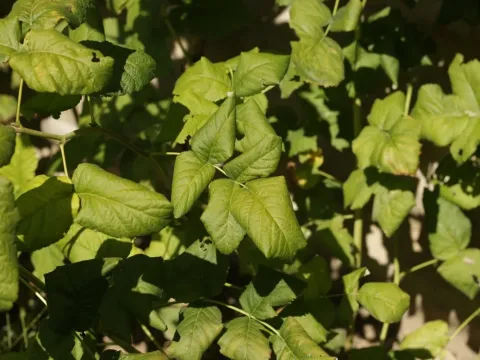
Raspberry leaf curl
Raspberry curly
Raspberry leaf curl is caused by the Raspberry leaf curl virus (RLCV), which is transmitted primarily by the raspberry aphid.
What the section contains
Raspberry leaf curl
The virus is a member of the luteovirus group, which specifically targets the phloem tissue of raspberry plants.
Once an aphid feeds on an infected plant, it becomes a carrier of the virus for the remainder of its lifespan.
The virus does not persist in the soil or in dead plant debris, as it requires living host tissue to survive.
Infection spreads through a plantation as aphids migrate between healthy and diseased canes, making control of the insect vector paramount.
The earliest symptoms include leaves that curl downwards, appearing hard, brittle, and often showing a bronze or dark green discoloration.
Stems of infected plants show shortened internodes, leading to a stunted and bushy growth habit.
Developing fruits are typically small, dry, and crumbly, often failing to reach maturity.
As the disease progresses over subsequent seasons, the entire plant becomes severely dwarfed and unproductive.
Infected canes show a characteristic reduction in vigor, making the symptoms clearly visible compared to healthy neighboring plants.
The spread of this disease is highly dependent on the lifecycle and population density of the aphid vector.
Warm, humid seasons provide ideal conditions for aphid multiplication and rapid movement throughout the raspberry field.
Overcrowded plantations with poor air circulation create favorable environments for aphids to thrive and spread the virus undetected.
Proximity to old, neglected, or wild raspberry patches increases the risk of initial infection via migrating insects.
Lack of regular garden maintenance allows weeds to serve as temporary habitats for aphids before they move onto the raspberry canes.
Raspberry leaf curl is a devastating viral disease for which there is no chemical cure.
Once a plant is infected, it will not recover and will continue to act as a source of the virus for the rest of the patch.
The cumulative effect of the virus is a significant loss in yield and fruit quality, eventually leading to the death of the plant.
If left unmanaged, the virus can spread throughout an entire plantation, necessitating the destruction of all infected specimens.
The financial impact on commercial growers is substantial, especially when the disease enters a propagation nursery.
Management relies entirely on prevention and strict sanitation practices to limit the spread of the virus.
All symptomatic plants must be immediately rogued out, including the root systems, and destroyed away from the garden.
Aggressive aphid management through the application of approved insecticides is necessary to break the cycle of viral transmission.
Always source nursery stock from certified, virus-tested suppliers to ensure the planting material is free of RLCV.
- Monitor plantings frequently for signs of leaf distortion.
- Maintain a weed-free environment to reduce aphid nesting sites.
- Establish new plantings far from old or wild raspberry stands.
- Sanitize pruning tools between rows to prevent potential mechanical spread.