
Celery mosaic virus
Potyvirus apii
The causal agent of this disease is the Celery mosaic virus (CeMV), which belongs to the Potyvirus genus. It is a filamentous plant virus containing a single-stranded RNA genome that specifically targets members of the Apiaceae family.
What the section contains
Celery mosaic virus
This virus has a broad host range among wild plants and cultivated crops within its family. It is transmitted in a non-persistent manner, which implies that the virus is acquired and transmitted by its insect vectors within seconds or minutes of feeding.
The virus cannot be transmitted through seeds, making the primary inoculum source environmental reservoirs, such as infected perennial weeds or overwintering celery crops that have remained in the field.
Various aphid species are the primary vectors of CeMV. They carry the viral particles on their mouthparts (stylets) after feeding on infected plant tissues and effectively inoculate healthy plants during subsequent feeding sessions.
Because the transmission is non-persistent, the virus spreads rapidly across a field, especially in areas with high aphid populations and favorable climatic conditions for insect movement.
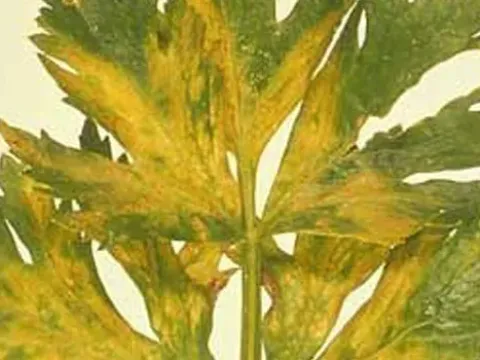
The most common symptoms include a distinct mosaic pattern on the leaves, characterized by alternating patches of light green and dark green tissue. This chlorotic appearance is often accompanied by leaf distortion.
Leaves frequently become crinkled, curled, and smaller than those of healthy plants. These deformities significantly impact the aesthetic and market value of the harvested crop.
Petiole development is often stunted; they become brittle, fibrous, and thinner, losing the characteristic crunch and succulence desired by consumers and the food processing industry.
In cases of early-season infection, the entire plant may show severe stunting, remaining significantly smaller throughout the growing period. This reduced biomass leads to poor yields.
Necrosis of leaf veins may occur in advanced stages of infection. The overall health of the plant is compromised, leading to a general chlorotic look that can easily be mistaken for nutritional deficiencies.
The development and spread of the virus are strongly correlated with the population dynamics of aphid vectors. Warm, dry weather conditions promote faster aphid reproduction and increased mobility between host plants.
Proximity to weeds belonging to the Apiaceae family, such as wild hemlock or wild celery, provides a constant source of infection. These wild hosts serve as bridges for the virus to enter commercial production fields.
Mechanical transmission can occur during agricultural practices like weeding, thinning, or harvesting. When sap from infected plants is accidentally transferred to healthy plants through handling or tools, the disease can spread.
High planting density contributes to the rapid spread of the disease. In closely packed rows, aphids move with ease from plant to plant, ensuring that a single infected plant can quickly become the source for an entire field.
The absence of proper crop rotation and the overlap of production cycles facilitate the survival of the virus. If young transplants are set near old, infected plants, the probability of infection becomes extremely high.
The economic impact of Celery mosaic virus is primarily realized through the loss of marketable yield. Deformed, stunted, and chlorotic plants do not meet quality standards, leading to heavy culling during sorting.
Quality degradation is a major issue, as the virus negatively affects the texture and flavor profile of the celery. These changes make the produce undesirable for fresh market consumption.
Viral infection weakens the plant's overall physiology, making it significantly more susceptible to secondary pathogens, including soil-borne fungi and soft rot bacteria, especially during post-harvest storage.
Yield reductions can be dramatic, with some studies suggesting that early infections can result in total loss of the crop in a specific area or block, requiring extensive field cleanup.
Since there are no chemical cures for viral plant diseases once they occur, the presence of CeMV in a field represents a long-term management challenge that affects the profitability of the entire farm operation.
The most effective strategy involves the elimination of weed reservoirs in and around the field. Keeping perimeters clean of wild celery and related species is a critical first line of defense.
Proactive aphid control is essential. Using systemic insecticides to reduce vector populations early in the growing season can significantly lower the rate of primary infection.
Spatial isolation between new crops and old, infested areas is mandatory. It is recommended to leave a significant distance between different batches of celery to disrupt the migration of vectors.
Utilizing high-quality, virus-free transplants is vital. Seedlings should be raised in screened greenhouses to prevent exposure to aphids until they are ready to be transplanted into the field.
Implementing strict sanitation protocols, such as removing infected plants immediately upon discovery and managing crop debris, helps break the disease cycle and minimizes the inoculum available for the next season.