
Chrysanthemum stunt viroid
Pospiviroid impedichrysanthemi
The causal agent of the disease is the Chrysanthemum stunt viroid (CSVd), a member of the Pospiviroidae family. It is a small, single-stranded circular RNA molecule that lacks a protein coat and relies entirely on the host plant's enzymatic machinery for replication.
What the section contains
Chrysanthemum stunt viroid
The viroid is highly stable in the environment and systemically infects all tissues of the chrysanthemum. Once inside the plant, it travels through the vascular system, effectively colonizing both the root zone and the vegetative parts.
Unlike most plant viruses, CSVd does not require insect vectors for transmission. It is primarily spread through mechanical means during routine horticultural activities, such as pinching, pruning, or taking cuttings.
Due to its microscopic nature, it can be transferred via the sap from infected plants to healthy ones through micro-wounds on stems or leaves. The viroid integrates into the host cell metabolism, disrupting normal plant growth and development.
Because of its high virulence and the difficulty of early detection, CSVd is classified as a quarantine organism in many countries, posing a significant threat to commercial floriculture.
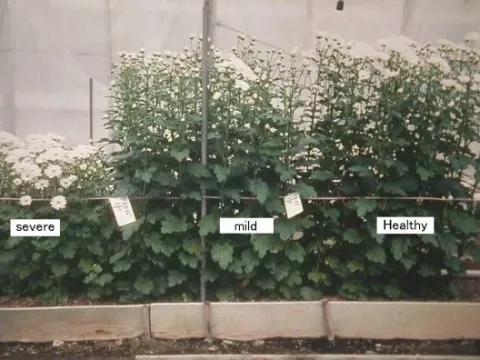
The most prominent symptom is stunted growth, where infected chrysanthemums appear significantly smaller than healthy ones. Internodes are drastically shortened, resulting in a compact, dwarfed appearance of the plant.
Leaves often become smaller, pale, and may exhibit chlorosis or curling. The overall foliage loses its vigor, and the plants may appear thin or sparse, which ruins the ornamental value of the flower.
Flowers show clear signs of infection as well: they become smaller, may lose their intense color, or exhibit abnormal shapes. Blooming is often premature or significantly delayed compared to healthy plants.
In some cases, symptoms remain latent, especially in favorable environmental conditions, which makes identifying infected plants during the early stages of the disease challenging.
- Severe reduction in plant height.
- Small, misshapen or pale flowers.
- Chlorotic and deformed leaves.
- Shortened internodes.
- Altered blooming schedule.
High plant density in greenhouses creates an ideal environment for the rapid spread of the viroid, as physical contact between plants is frequent during maintenance and irrigation.
Contaminated horticultural tools are the primary vehicles for transmission. Pruning shears, knives, and other equipment used for propagation can carry the viroid if not properly sterilized between uses.
The use of cuttings from infected mother plants is the most dangerous route of transmission. If a mother plant is infected, the entire batch of cuttings produced from it will harbor the viroid, leading to widespread infection.
Water splashes during irrigation can facilitate the transfer of viroid particles from plant to plant. Any minor injury to the roots or stems provides an entry point for the pathogen.
Temperature fluctuations in the greenhouse can mask symptoms. Warm weather often promotes faster vegetative growth, which can temporarily hide the stunting effects, leading growers to believe the plants are healthy.
The economic impact of the Chrysanthemum stunt viroid is significant, as it renders the floral product unsalable. Infected plants lose their commercial appeal and fail to meet quality standards.
Infection induces a physiological decline in the plant's health, making chrysanthemums more susceptible to secondary fungal and bacterial infections, further reducing crop yield.
The necessity to discard entire batches of infected stock creates severe financial losses for producers. In large-scale greenhouse operations, a single infected mother plant can cause a cascade effect across the entire facility.
Due to its high infectivity, a lack of strict quarantine measures can lead to an epidemic that covers an entire greenhouse operation in just a few production cycles.
There is no chemical treatment available to cure viroid-infected plants. Consequently, the only effective management strategy is the complete removal and destruction of infected stock to prevent further spread.
The most important control measure is to source certified disease-free material, typically propagated through meristem culture, which ensures the plant is free from viroid particles.
Rigorous sanitation of all tools is essential. Equipment must be sterilized between each plant or batch using approved disinfectants such as alcohol solutions, bleach, or specialized virucidal agents.
Regular visual inspection is critical. Any plant exhibiting symptoms of stunting or unusual growth should be immediately rogued out and destroyed to eliminate the source of the infection.
Strict hygiene protocols for personnel, including hand and clothing disinfection when moving between different sections of the greenhouse, are vital to prevent human-assisted transmission.
If there is any suspicion of CSVd presence, laboratory testing, such as RT-PCR, is necessary to provide an accurate diagnosis, as symptoms can often overlap with nutrient deficiencies or other pathogens.