
Citrus bent leaf viroid
Apscaviroid curvifoliumcitri
Description
Symptoms
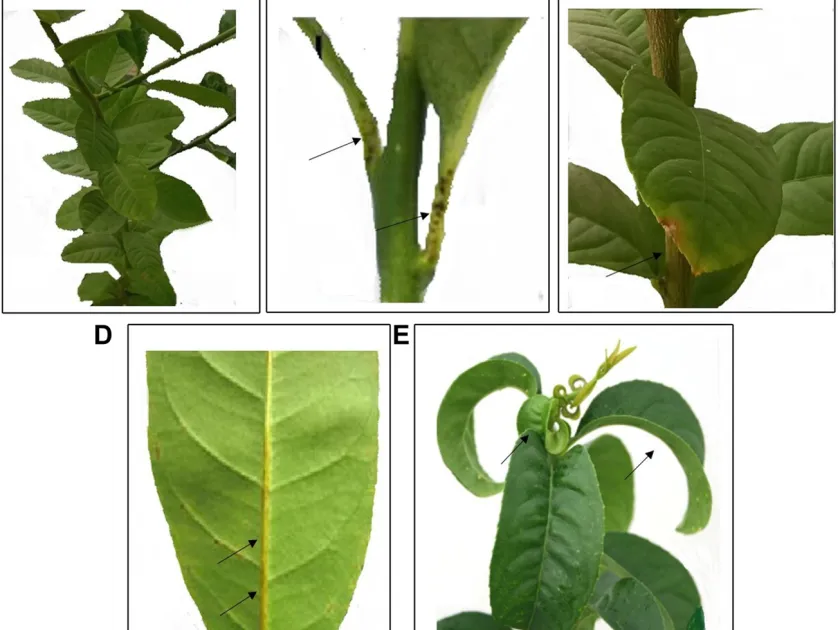
The primary symptom of this disease is the characteristic bending or curling of leaves, which explains the common name. Leaf blades often appear deformed, thickened, and sometimes smaller than normal foliage.
Chlorotic spots or a subtle mosaic pattern may develop on the leaf surface. These symptoms are often more prominent during the initial stages of the growing season when new leaves are unfolding.
Affected trees may exhibit stunted growth, resulting in reduced branch length and diminished overall canopy density. The tree's vigor decreases significantly as the viroid interferes with normal nutrient allocation.
In certain susceptible citrus varieties, the bark might show abnormal physiological changes. The cumulative effect of these symptoms often leads to a general decline in the tree's physical condition over time.
Because symptoms are highly variable and dependent on the rootstock-scion combination, visual diagnosis is often insufficient and must be supplemented by laboratory testing.
Pathogen
The causative agent of this disease is the Citrus bent leaf viroid (CBLVd), a member of the Apscaviroid genus. It consists of a single-stranded circular RNA molecule that lacks any protein capsid, classifying it as a viroid.
CBLVd relies entirely on the host plant's enzymatic machinery for its replication process. Due to its simple structure, the viroid is remarkably stable in the environment and can persist on contaminated agricultural tools.
The transmission of this pathogen is primarily associated with human activity. Grafting, budding, and pruning using contaminated tools are the most common ways that the viroid spreads within and between citrus orchards.
Belonging to the Pospiviroidae family, this pathogen is notorious for inducing latent infections. Plants can harbor the viroid for long periods without showing any discernible signs, which masks the source of the infection.
Detection relies on molecular methods, with reverse transcription-polymerase chain reaction (RT-PCR) being the gold standard for identifying the viroid even in asymptomatic carrier plants.
Why it matters
Citrus bent leaf viroid causes significant economic losses by reducing the total fruit yield and impairing the development of the canopy. The impact on production volume is often cumulative, worsening year by year.
Fruit quality is frequently compromised, resulting in smaller sizes, irregular shapes, and potentially reduced sugar content. This lowers the commercial value of the crop in both fresh and processed markets.
The infection puts long-term stress on the tree's metabolism, increasing its susceptibility to other abiotic stressors like drought or salinity, as well as secondary biotic infections.
The shortened productive life of the orchard requires premature removal and replanting of the infected trees. This represents a heavy financial burden for orchard owners and commercial citrus producers.
International and domestic phytosanitary regulations regarding the movement of citrus propagative material are strict due to the risk of spreading this pathogen into new, uninfected growing regions.
Protection
The most effective strategy is the use of pathogen-tested, certified disease-free nursery stock. Sourcing material from reliable programs ensures that new trees are free from the viroid from the start.
Sanitization of pruning shears, knives, and other mechanical equipment is crucial. Disinfecting tools between each tree using recommended chemical solutions is the primary way to prevent mechanical transmission.
Implement a rigorous phytosanitary monitoring program to detect symptomatic trees early. Infected trees should be removed and destroyed to mitigate the risk of further spread in the orchard.
Limit the movement of machinery and workers between infected and healthy blocks. Maintaining orchard hygiene and training staff on the risks of viroid transmission are essential components of management.
- Utilize only certified virus-indexed citrus nursery stock.
- Establish strict tool disinfection protocols for all pruning tasks.
- Conduct regular surveys to identify and remove symptomatic plants.
- Implement molecular diagnostic screening in high-risk areas.
Discussion
No discussions yet — be the first.