
Chromatic spot
Nepovirus chromusivum
Description
Symptoms
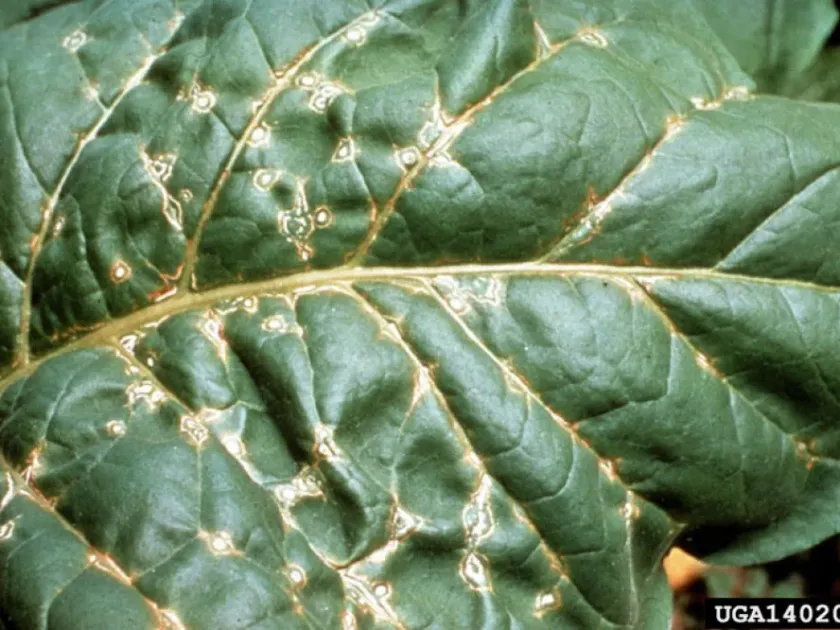
The primary symptom of the disease is the appearance of characteristic chlorotic spots on plant leaves, which eventually acquire a bright, contrasting color. The patterns can range from tiny dots to large mosaic spots or ring-like structures.
As the virus progresses, deformation of leaf blades occurs, causing curling and stunted growth. The plants become dwarf-like, internodes shorten, which significantly alters their typical habitus.
In the generative phase, buds may fail to form correctly, and flowers can be deformed or exhibit atypical, variegated coloration. Fruits are often underdeveloped, irregular in color, and show low market quality.
Visual signs often appear systemically, affecting both young and old leaves, distinguishing the viral infection from localized fungal lesions. In severe cases, premature leaf drop occurs.
Visual inspection is insufficient for accurate diagnosis, as symptoms can resemble nutrient deficiencies. Laboratory analysis, such as ELISA or PCR, is required to confirm the presence of viral particles.
Pathogen
The causative agent is Nepovirus chromusivum, a virus belonging to the nepovirus group. These viruses have a spherical capsid shape and contain single-stranded RNA.
A specific biological feature of this pathogen is its ability to spread through soil-borne nematode vectors, particularly species of the genera Xiphinema and Longidorus.
The virus has a wide host range, infecting both woody and various herbaceous plants, including fruit and vegetable crops. Inside the host, the pathogen causes a systemic infection, penetrating xylem and phloem tissues.
Survival of the pathogen between seasons is ensured by perennial reservoir plants, in whose roots the virus maintains its infectious capacity for several years.
Virus transmission occurs both through damaged root contact and contaminated planting material, which complicates the control of the infection spread within an agrocenosis.
Conditions for development
The most favorable conditions for viral development are periods with moderate temperatures and high soil moisture, which promote the activity of nematode vectors.
Disease spread is closely linked to soil physical and chemical properties: heavy, clayey soils facilitate more active movement of nematodes compared to sandy substrates.
Virus migration within plantings accelerates during intensive irrigation, as moisture provides an optimal environment for vector survival and maintains the turgor of infected tissues.
Infection often occurs during spring when sap flow and root formation begin, making plants particularly vulnerable to invasion.
The presence of weeds on the field creates a favorable environment for virus accumulation, as many weeds serve as hidden reservoirs without showing visible symptoms.
Why it matters
Chromatic spot causes significant economic damage, reducing crop yields by 20–50% depending on the severity of the infection and the timing of the initial attack.
Harmfulness manifests in the weakening of plant immunity, making them more susceptible to secondary infections such as bacterial rots or fungal pathogens.
Product quality suffers significantly: fruits lose flavor, become smaller, and ornamental plants lose their marketability and aesthetic value.
Long-term presence of the virus on a plot leads to plantation degradation, necessitating the complete replacement of planting material and long-term quarantine of infected fields.
Costs for disease management include not only chemical treatments but also costly agrotechnical soil decontamination from nematodes, increasing production costs.
Protection
The primary measure is the use of certified, virus-free planting material that has been verified in phytosanitary laboratories.
Controlling nematode vector populations through the application of specialized nematicides and maintaining crop rotation that excludes susceptible species is essential.
Systematic removal and destruction of infected plants along with their root systems are recommended to prevent virus transmission to healthy individuals.
High agrotechnical standards must be maintained, including the control of reservoir weeds that often serve as the source of infection at the start of the season.
To prevent spreading the infection with tools, mandatory disinfection is required during pruning and other operations, using a 5-10% sodium hypochlorite solution.
Discussion
No discussions yet — be the first.