
Citrus exocortis
Pospiviroid exocortiscitri
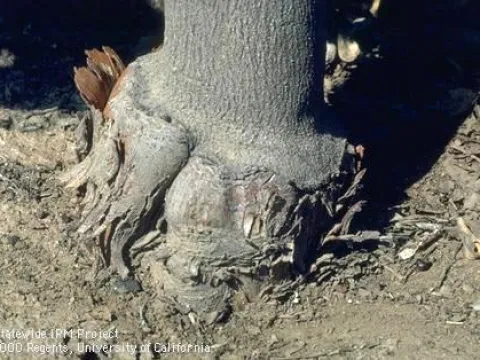
The hallmark symptom of Citrus exocortis is the scaling and splitting of the bark on the rootstock, which resembles dry, thin wood shavings.
What the section contains
Citrus exocortis
In susceptible cultivars, the disease manifests as severe stunting, where trees remain significantly smaller than their healthy counterparts.
Infected trees often exhibit shortened internodes and a twisted, irregular growth pattern of branches, leading to a deformed overall crown shape.
Foliage may show chlorosis or premature senescence, and fruit yields are drastically reduced as the tree loses its vigor over time.
Diagnosis is challenging because the pathogen often remains latent for several years, showing no external symptoms while spreading systemically.
The disease is caused by Citrus exocortis viroid (CEVd), which is a small, circular, single-stranded RNA molecule lacking a protein coat.
The viroid is highly infectious and is transmitted primarily through mechanical means via contaminated tools during pruning or budding operations.
Because it lacks a traditional biological structure, the viroid is extremely hardy and can persist on knife blades or saws for extended periods.
Natural transmission can occur through root grafts or contact between the roots of adjacent infected and healthy trees in the orchard.
Although transmission via seeds is rare, the use of infected vegetative propagation material remains the primary driver of disease spread.
High temperatures are a critical factor that promotes the replication and systemic movement of the viroid within the vascular tissue of the host.
The disease is most prevalent in warm, humid regions where citrus trees experience active growth, favoring the multiplication of the viroid.
Orchard management practices that involve frequent pruning provide multiple opportunities for the transmission of the pathogen if protocols are ignored.
The physiological stress of the tree does not cause the disease, but it can exacerbate the decline and impact of the viroid on the crop's health.
Long-term exposure to the pathogen ensures that the viroid eventually saturates all parts of the tree, from the rootstock to the terminal branches.
Citrus exocortis causes substantial economic loss due to significant reductions in both fruit size and the overall quantity of the harvest.
The destruction of the bark structure interferes with the tree's nutrient and water transport system, leading to gradual branch dieback and decline.
Trees infected with the viroid have reduced resilience and are more prone to opportunistic pathogen attacks, which can lead to premature tree death.
The persistent nature of the infection makes it impossible to cure, forcing growers to remove entire trees to save the surrounding blocks.
Widespread infection within a grove can force the replanting of entire areas, creating a massive financial burden for citrus producers.
The primary control measure is the exclusive use of certified, viroid-free budwood and rootstock sourced from reputable nurseries.
Rigorous sanitation of all pruning and budding tools using bleach or specialized disinfectants is essential after contact with each individual tree.
Regular phytosanitary inspections and testing of trees, especially in mother blocks, help identify and eliminate asymptomatic carriers.
Implementing thermotherapy or meristem-tip grafting allows researchers to clean infected germplasm and restore the health of valuable citrus varieties.
Strict quarantine and biosecurity measures should be observed to prevent the entry and spread of infected plant materials across regional borders.