
Grapevine fanleaf virus
Nepovirus foliumflabelli
The causal agent of this disease is the Grapevine fanleaf virus (GFLV), a member of the Nepovirus genus. It is one of the most economically significant viruses affecting grapevines globally.
What the section contains
Grapevine fanleaf virus
The virus consists of spherical particles approximately 30 nm in diameter containing single-stranded RNA. Its high genetic diversity makes the development of resistant grape varieties extremely challenging.
The virus spreads systemically throughout the host plant, infecting all tissues including roots, canes, and leaves. Within the host cells, it interferes with vital metabolic pathways, leading to severe physiological disruptions.
Infected vines serve as the primary reservoir for the virus. Furthermore, the virus can persist for several years in the soil within decaying root fragments left after vine removal.
The virus is naturally transmitted by the soil-inhabiting dagger nematode, Xiphinema index. Additionally, it can be spread through grafting or the use of infected vegetative propagation material.
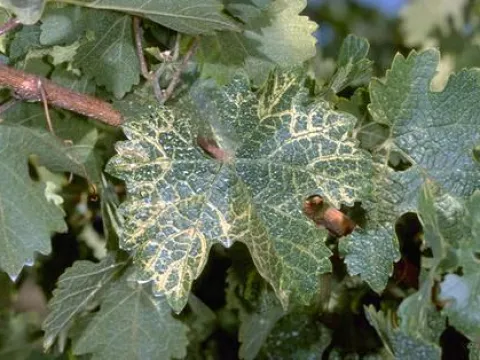
The most distinctive symptom is leaf malformation, where leaves become fan-shaped due to the narrowing of the petiole sinus and the abnormal branching of primary leaf veins.
Yellow mosaic patterns, chlorotic rings, or mottling appear on the foliage. These symptoms are most prominent in the early spring but may become masked as temperatures increase during the summer months.
Affected shoots exhibit shortened internodes, zig-zag growth, and occasional double nodes or fasciation. This gives the vine a stunted, bushy, or "witches' broom" appearance.
Inflorescences suffer from heavy flower drop (coulure) and poor fruit set, leading to "millerandage" or uneven berry sizing. Clusters become loose, significantly reducing both yield and harvest quality.
Over several years, infected vines show progressive decline, including reduced vigor, poor cane maturation, and eventually, the complete collapse of the plant.
The transmission of the virus is strictly dependent on the presence of the Xiphinema index nematode in the soil. This vector is the primary factor limiting the speed of disease expansion within a site.
Optimal environmental conditions, such as appropriate soil moisture and moderate temperatures, favor nematode movement and feeding. Infections typically expand from focal points across the vineyard.
Long-distance spread of the virus occurs almost exclusively through the movement of contaminated nursery stock or the transplanting of infected vine material from one region to another.
Cultural practices, such as deep plowing or heavy equipment usage that relocates infested soil, facilitate the spread of the nematode vector and contribute to new infection sites.
The disease has a latent incubation period, meaning an infected vine may not show clear symptoms for several months or even a year, making early diagnosis and containment difficult.
Fanleaf degeneration is one of the most destructive viral diseases of grapes. It causes a continuous and significant reduction in fruit yield, often reaching 80% loss in heavily infested vineyards.
Beyond quantity, fruit quality is severely compromised. Berries develop unevenly, fail to reach full sugar maturity, and lose their organoleptic properties, rendering them unsuitable for high-quality wine production.
The virus weakens the structural integrity of the vine, making it more susceptible to environmental stress, drought, and secondary infections, significantly shortening the lifespan of the vineyard.
Economic damage is substantial, encompassing the loss of annual revenue, the high cost of site remediation, and the expense of replanting the affected sections of the vineyard.
Since there is no cure for viral infection in woody crops, the loss of productive, high-quality vines represents a permanent reduction in the asset value of the agricultural enterprise.
The use of certified, virus-free planting material is the cornerstone of control. It is vital to source vines only from nurseries that employ rigorous virus testing and sanitation protocols.
Before planting a new vineyard, testing the soil for the presence of Xiphinema index is essential. If the nematode is detected, specific soil treatment or a long fallow period is required.
Removing and destroying infected vines, including their root systems, is crucial to stop the virus from persisting in the soil and spreading to healthy adjacent vines.
Implementing a crop rotation strategy using non-host plants can help reduce the population of nematodes in the soil before establishing a new vineyard.
Regular monitoring of the vineyard for early symptom expression allows for the rapid identification of potential foci, enabling growers to take localized action before the virus spreads across the entire block.