
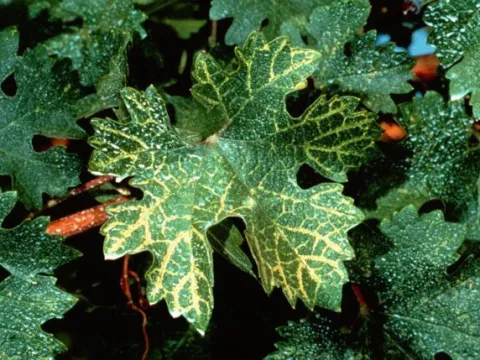
Grapevine fanleaf degeneration
Maldovirus vitis
Grapevine fanleaf degeneration is caused by the Grapevine fanleaf virus (GFLV), which is a member of the genus Nepovirus. It is one of the most serious viral diseases affecting grapevines globally.
What the section contains
Grapevine fanleaf degeneration
The virus is an obligate parasite that requires a living host to survive. It is transmitted in nature by soil-inhabiting nematodes of the genus Xiphinema, which acquire the virus while feeding on infected roots.
The pathogen is systemic, meaning it spreads throughout the vascular system of the grapevine, affecting roots, shoots, leaves, and reproductive tissues.
Besides nematodes, the virus is spread through human activities, primarily by using infected grafting material or cuttings from diseased mother vines.
The virus is remarkably stable and can persist in soil for several years even in the absence of a host, provided the nematode vectors remain present in the field.
The most iconic symptom is leaf deformation, where leaves become fan-shaped, asymmetrical, and exhibit yellowing patterns such as mosaic or banding along the veins.
Shoots show severe growth abnormalities, including stunted internodes (short nodes), zigzag growth patterns, and double-budding, which is a classic indicator of the disease.
Flowering and fruit set are heavily impacted; clusters often show poor development, with many berries failing to set, leading to loose and straggly bunches.
Infected vines frequently exhibit a bushy appearance due to excessive lateral shoot production (suckering), which gives the foliage an uncharacteristic density.
- Yellow mosaic or chlorotic spotting on leaves.
- Significant stunting and overall loss of vine vigor.
- Reduced cluster size and uneven berry ripening.
- Failure of canes to harden properly before winter, leading to cold injury.
The development of the disease is strictly tied to the life cycle and distribution of Xiphinema nematodes, which act as the primary biological vectors.
Moist, well-structured soils provide optimal conditions for the survival and movement of nematodes, making heavy clay or silty soils high-risk areas for fanleaf spreading.
Infection spreads easily in vineyards where the same rootstocks are used for long periods, allowing the virus to establish permanent reservoirs in the soil.
Human activities, such as transferring soil via heavy machinery or equipment between infected and non-infected blocks, are major drivers of disease distribution.
Environmental factors that encourage deep root growth allow nematodes to find virus-rich tissue, thereby facilitating more frequent and efficient transmission of the pathogen.
The disease causes a continuous decline in vine productivity, often resulting in complete yield failure within a few years of initial infection.
Fruit quality is severely compromised; berries exhibit low sugar levels and high acidity, making them unsuitable for both fresh market and high-quality wine production.
Infected vines suffer from chronic physiological stress, which increases their susceptibility to other biotic and abiotic stressors, such as drought or fungal pathogens.
The longevity of the vineyard is drastically reduced; since there is no cure, entire sections of a vineyard may need to be replanted, causing massive economic losses.
The spread of the virus across a site can make an entire vineyard unprofitable, leading to forced abandonment of the land for grape production for many years.
The most crucial strategy is to start a vineyard using certified virus-free nursery stock, which has undergone rigorous testing and sanitization procedures.
When symptoms appear, infected vines must be rogue (removed) entirely, including all root systems, to prevent the nematode population from feeding on the source of the virus.
Pre-plant soil testing for Xiphinema nematodes is essential; if high populations are found, fumigation or a period of non-host crop rotation is recommended.
Strict hygiene protocols must be followed during pruning, grafting, and cultivation, ensuring that all tools are disinfected to avoid mechanical transmission of the virus.
Long-term strategies involve using nematode-resistant rootstocks or implementing cover crops that suppress nematode populations in the vineyard environment.