
Cucumber ringspot virus
Nepovirus cucumis
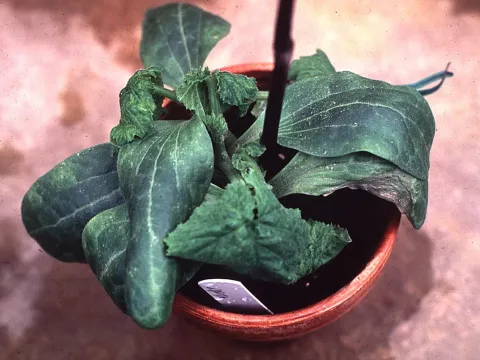
The most distinctive symptom of Cucumber ringspot virus is the appearance of chlorotic or necrotic ring-like spots on the foliage. These marks often develop into irregular patterns that significantly affect leaf health.
What the section contains
Cucumber ringspot virus
Affected plants often show stunted growth and shortened internodes, leading to a compact and deformed habit. The leaves may become crinkled, curled, or exhibit a mosaic-like yellowing pattern throughout the canopy.
Fruits are severely impacted, often displaying malformations, bumps, or irregular coloration. This damage makes the produce unsuitable for commercial sale, resulting in significant post-harvest losses.
The disease progresses systemically, causing the premature senescence and wilting of plant tissues. Often, the flowers drop off prematurely, leading to a drastic reduction in total fruit set and yield potential.
Visual diagnosis is essential but can be difficult as symptoms may overlap with other viral or physiological disorders. Laboratory molecular assays are the only way to definitively confirm the presence of the pathogen.
The pathogen responsible is Nepovirus cucumis, a virus belonging to the Secoviridae family. Its genome is characterized by positive-sense single-stranded RNA, which replicates efficiently within host cells.
This is a systemic viral disease that spreads rapidly throughout the plant's vascular tissue, specifically via the phloem. Once established, the virus disrupts cellular metabolism and nutrient transport.
The virus has a narrow to moderate host range, primarily targeting members of the Cucurbitaceae family, including cucumbers, melons, and squash. It can also be found in various common weed species.
Transmission occurs through nematode vectors present in the soil, as well as through mechanical transmission by farm equipment. Seed transmission has also been documented, making it a critical pathway for long-distance spread.
The virus is notable for its stability, allowing it to persist in the soil and infect subsequent crops. This persistence makes it a challenging pathogen to manage in greenhouses and open fields alike.
The development of this virus is highly correlated with the environmental conditions that favor its vectors, the soil-dwelling nematodes. Moist, loamy soils are ideal environments for nematode survival and transmission.
Moderate temperatures generally promote the expression of symptoms in host plants. While extreme weather may slow down certain biological processes, the virus remains active within the host tissues.
Greenhouse conditions often facilitate rapid spread due to the close proximity of plants. Frequent handling of plants for pruning or harvesting provides ample opportunities for mechanical transmission.
Environmental stress, such as poor water management or nutrient deficiencies, increases the susceptibility of cucumber plants to the virus. Vigorous, healthy plants are better able to withstand lower levels of infection.
Effective management of weeds around the field perimeter is necessary to prevent the accumulation of the virus during the off-season. Neglected edges act as primary reservoirs for new outbreaks.
The economic impact of Cucumber ringspot virus is severe, particularly in intensive agricultural zones. Growers often face total loss of crop quality, rendering the harvest unmarketable.
Beyond quantity, the virus directly affects fruit quality, which is the primary source of profit for many farmers. Malformed fruits are consistently rejected by retailers and consumers.
The persistent nature of the virus in the soil necessitates long-term management strategies. Fields infested with the virus may require extensive quarantine or years of crop rotation to reduce inoculum levels.
Production costs increase as farmers are forced to invest in diagnostic testing, intensified sanitation, and, in some cases, soil fumigation to protect their investments.
In cases of severe infestation, the inability to effectively treat systemic viral infections means that destruction of the entire crop is often the only remaining management option.
Preventative measures form the cornerstone of management. Implementing a rigorous crop rotation program that excludes cucurbits for several years is the most effective way to manage nematode populations.
- Sourcing only certified, virus-tested seeds to ensure the crop starts free of pathogens.
- Sanitizing tools and machinery thoroughly after working in potentially infected areas.
- Eliminating weed reservoirs both within and surrounding the production area.
- Monitoring fields regularly for early symptoms and immediately removing/destroying infected plants.
- Utilizing resistant or tolerant cultivars developed through breeding programs.
In indoor production systems, soil solarization or chemical fumigation may be used to reduce the prevalence of vector nematodes prior to planting. Maintaining strict greenhouse hygiene is crucial.
Integrated Pest Management (IPM) practices, which prioritize the health of the plant and control of the vector populations, remain the most sustainable strategy for long-term production success.