
Bean yellowing virus
Luteovirus phaseoli
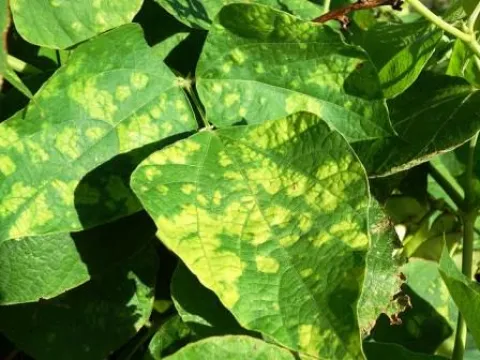
The primary symptom of the disease is a characteristic yellowing of the leaf blade, often starting from the upper leaves. Gradually, chlorosis spreads across the entire plant, causing it to take on a light yellow or golden color.
What the section contains
Bean yellowing virus
Infected plants exhibit significant growth retardation, characterized by stunted development and a weak root system. Internodes become shortened, which gives the plant a compact and deformed appearance.
In severe cases, flowering is significantly reduced or completely ceases, leading to a critical drop in bean pod formation. Leaves may drop prematurely, leaving stems exposed and reducing the plant's overall photosynthetic activity.
Seeds within the pods of infected plants are often small, shriveled, or show signs of incomplete maturation. During early developmental stages, seedlings may appear weak and twisted, which is often misidentified as a micronutrient deficiency.
Diagnosis is challenging because symptoms vary depending on the bean cultivar and environmental conditions. Laboratory analysis, such as ELISA or PCR, is required to confirm the viral etiology of the disease.
The disease is caused by the virus Luteovirus phaseoli, which belongs to the Luteoviridae family. These are specialized phytopathogens that are localized primarily within the phloem tissues of host plants.
This virus is an obligate parasite, incapable of spreading independently without the assistance of specific vectors. It accumulates in the plant's vascular system, disrupting the normal transport of photosynthates.
The main vectors of this virus in agricultural ecosystems are various species of aphids. Aphids acquire the virus while feeding on an infected plant and transmit it to healthy specimens during subsequent feeding bouts.
The virus follows a persistent transmission type, meaning the vector retains the ability to infect plants for a long duration after acquisition. This significantly increases the risk of rapid disease spread throughout the field.
Mechanical transmission via sap or contact between plants in the field is extremely rare. The primary biological cycle of the infection is inextricably linked to the population dynamics of aphid vectors.
Favorable conditions for epiphytotics include warm and dry weather, which facilitates rapid population growth of aphids. Higher vector density leads to more intensive pathogen transmission across the crop.
Infection often occurs during the development of the first true leaves, when plants are most vulnerable to primary infestation. The timely migration of winged aphid forms often coincides with the spring growth of beans, creating high infection pressure.
The presence of weeds around fields serves as a reservoir for both the virus and its insect vectors. The virus can persist within these weed hosts throughout the off-season.
Poor crop rotation and monocropping of beans over several years encourage the buildup of viral inoculum in the soil and the local ecosystem. Favorable conditions for the survival of overwintering aphid stages further exacerbate the situation.
Water stress combined with extreme temperatures weakens the bean plant's immune system, making it more susceptible to viral invasion. Optimal growth conditions help plants better withstand primary infection attempts.
Bean yellowing virus causes significant economic losses, reducing pod yields by 30–70% depending on the severity of the outbreak. In cases of intense infection, total loss of marketable quality is possible.
The quality of planting material is severely compromised in infected plants. Seeds lose germination rate, vigor, and overall weight, rendering them unsuitable for use as future seed stock.
The disease negatively impacts the biochemical composition of beans, reducing protein and starch content. This deteriorates both the visual quality of the product and its nutritional value for consumers.
Costs associated with protecting crops from aphid vectors significantly increase production expenses. The necessity of multiple insecticide applications places a heavy burden on agricultural budgets.
Resistance to environmental stress factors is virtually eliminated in virus-infected plants. Such plants perish more quickly from drought or secondary pathogens, leading to reduced stand density and poor crop uniformity.
The key management strategy is the control of insect vectors, particularly aphids. The use of systemic insecticides during early growth stages of beans effectively helps contain the primary spread of the virus.
It is essential to maintain strict spatial isolation between bean fields and other legume crops that may act as intermediate hosts for the virus. This reduces the risk of infection spreading from adjacent areas.
An important preventive measure is the systematic eradication of weeds within and around fields. Regular cleaning of field margins removes both overwintering sites and primary food sources for the vectors.
Utilizing virus-resistant cultivars is the most sustainable and promising control method. It is recommended to select locally adapted seed material that possesses genetic tolerance to luteoviruses.
Following a crop rotation plan where beans are not planted on the same field for at least 3–4 years significantly lowers the infectious background. Additionally, ensuring optimal mineral nutrition helps provide plants with the resources needed for natural resistance.