
Beet curly top
Becurtovirus betae
The disease is caused by Becurtovirus betae, a virus belonging to the Geminiviridae family. This pathogen is a systemic agent that disrupts the vascular system, specifically the phloem of the plant.
What the section contains
Beet curly top
The virus is transmitted exclusively by the beet leafhopper, Circulifer tenellus. Once the insect acquires the virus by feeding on an infected plant, it remains a carrier for the rest of its life, providing a persistent mode of transmission.
The host range is quite broad, affecting not only sugar beets but also table beets and chard. Furthermore, the virus persists in various wild weed species, particularly those in the Amaranthaceae family, which serve as overwintering reservoirs.
Its genome consists of a single-stranded circular DNA molecule, making it highly stable. Transmission to new crops occurs when the leafhoppers migrate from drying vegetation to fresh, green host plants in the spring and summer months.
Upon infection, the virus particles move through the phloem to the meristematic tissues. This causes significant changes in growth regulators, leading to the characteristic stunted and deformed development of the plant.
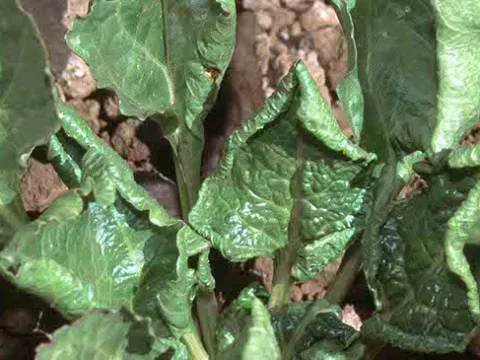
The most distinctive symptom is the upward curling of the leaves, which become leathery, thickened, and brittle. The margins of the leaves often roll inward toward the midrib, giving the plant a stunted appearance.
Vein swelling and discoloration are common indicators of the disease. The veins on the undersides of the leaves may become raised and exhibit a yellow or necrotic appearance, often accompanied by bumpy, crinkled leaf surfaces.
Young plants infected early in the season are severely dwarfed. The internodes become extremely shortened, resulting in a rosette growth pattern that gives the plant a compact, stunted "curly" look.
The root system is significantly impacted, showing poor development and often displaying darkened, necrotic vascular rings when sliced. This prevents the normal transport of nutrients and sugar throughout the root.
Overall, the plant stops growing and may exhibit premature yellowing or reddening. In severe cases, the entire plant may wilt and die as the vascular function is completely compromised by the viral load.
Disease outbreaks are highly dependent on the population dynamics of the Circulifer tenellus leafhopper. Hot, dry weather conditions facilitate the movement of the insects and increase the rate of virus transmission.
The prevalence of the virus is often linked to drought conditions, as the insects move from wild, drying rangelands into irrigated sugar beet fields. A moisture-stressed crop is also less resilient to the impact of the viral infection.
The presence of wild weed hosts near the agricultural fields provides a habitat for the leafhoppers to reproduce and acquire the virus. Effective weed management is crucial in reducing the initial local inoculum.
Mild winters allow the insect vectors and the virus to survive on winter annual weeds. When spring arrives, these infected insects migrate to nearby emerging crops, triggering early-season disease spread.
Geographical proximity to traditional breeding grounds of the leafhopper significantly increases the risk of the disease. Consequently, planting dates and field location relative to native host vegetation are key environmental factors.
Beet curly top is one of the most destructive diseases for sugar beet production, potentially leading to total crop failure. The damage is cumulative, affecting both the yield quantity and the technical quality of the roots.
The accumulation of sucrose is drastically reduced in infected plants, rendering the harvest unsuitable for commercial sugar processing. The reduced root size and low sugar content directly impact the profitability of the crop.
The presence of necrotic vascular tissue reduces the quality of the raw material, causing problems during the extraction process at processing plants. This increases processing costs and waste.
Plants affected at the seedling stage rarely recover and usually die, leaving gaps in the field that cannot be replanted. This uneven stand leads to significant yield losses across the affected area.
Furthermore, because the disease suppresses the plant's metabolism, affected crops become more susceptible to other secondary infections and root rots, complicating the overall management of the field.
The primary control strategy focuses on managing the leafhopper population. Chemical control using systemic insecticides at the time of seedling emergence is the most effective approach to protect young plants.
- Monitor leafhopper populations using yellow sticky traps.
- Control weeds in the vicinity to remove virus reservoirs.
- Use resistant or tolerant sugar beet hybrids if available.
- Maintain optimal irrigation to keep plants vigorous.
- Adjust planting dates to avoid the peak flight of leafhoppers.
Cultural practices, such as maintaining good weed control in field margins and fallow lands, significantly reduce the number of insects that enter the beet fields during the season.
Implementing a proper crop rotation system can help in breaking the cycle of the vector and the virus. Avoid planting sugar beets near fields that were previously known to have high insect activity.
In regions with high disease pressure, using floating row covers or other physical barriers for young plants can provide temporary protection, although this is usually limited to small-scale or research plots.