
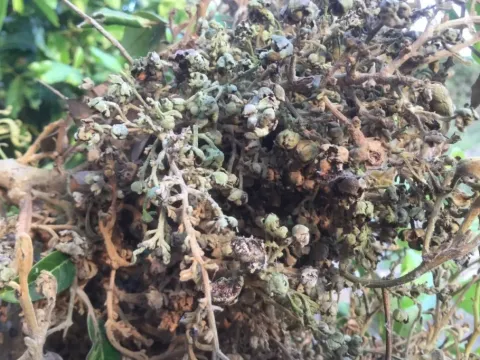
Longan witches broom
Longan witches
The disease known as witches broom in longan (Dimocarpus longan) is primarily caused by phytoplasmas, which are specialized bacteria that lack a cell wall and reside within the phloem tissues of the plant.
What the section contains
Longan witches broom
These pathogens are transmitted from infected to healthy trees by the eriophyid mite, Eriophyes dimocarpi, which acts as the main vector for the transmission of the infectious agent during feeding.
Once introduced into the plant, the phytoplasmas manipulate the host's hormonal regulation, forcing the tree to redirect nutrients toward the development of abnormal vegetative structures.
The pathogen does not survive long outside the plant or the vector, making the control of mite populations critical to preventing the spread of the disease within the orchard.
Genetic diversity of longan cultivars influences the susceptibility and the rate at which the disease progresses throughout the tree, with some varieties showing more severe symptoms than others.
The most distinctive symptom is the proliferation of buds, resulting in dense clusters of stunted, misshapen twigs that visually resemble a broom, hence the common name of the disease.
Leaves on the affected branches are typically smaller than normal, exhibiting chlorosis (yellowing), and may appear thicker or tougher in texture compared to healthy foliage.
Flower production is severely disrupted; affected branches often fail to flower at all, or produce malformed panicles that are incapable of setting viable fruit, leading to total yield loss.
As the disease progresses, the tree architecture becomes distorted, with branches losing their natural shape and becoming cluttered with dead or diseased wood that fails to produce canopy growth.
Severe infestations lead to a overall decline in tree health, as the metabolic energy is wasted on sustaining these parasitic growths rather than vegetative development or fruit production.
The spread of the disease is highly dependent on the lifecycle of the mite vector, Eriophyes dimocarpi, which thrives in warm and humid tropical environments suitable for longan cultivation.
Continuous flushing of new leaves throughout the year provides an ideal food source for the mites, enabling them to maintain high population levels and spread the pathogen efficiently.
Poor orchard sanitation, particularly the failure to remove pruned materials, allows the disease to persist in the field, serving as a permanent inoculum source for the entire grove.
Close spacing between trees facilitates the movement of mites via wind or physical contact, which significantly accelerates the rate of infection across a commercial orchard.
Abiotic stress factors such as poor soil nutrient management or irregular irrigation can weaken the plant's systemic defense mechanisms, making it easier for phytoplasmas to colonize the tree.
Longan witches broom poses a significant economic threat to farmers, as the primary consequence of infection is the complete loss of fruit production on affected branches or entire trees.
The chronic exhaustion of the tree due to the redirection of nutrients results in stunted growth and a drastically reduced lifespan, often necessitating the early removal and replanting of the trees.
Increased operational costs arise from the need for frequent acaricide applications to manage mite populations and the labor-intensive requirements for systematic pruning and destruction of infected tissues.
In cases where the disease reaches epidemic levels, it can devastate local agricultural industries by reducing the availability of high-quality exportable longan fruit.
The lack of effective curative chemical treatments means that once a tree is heavily infected, it must be removed, representing a total loss of the capital invested in that specific tree.
The primary control strategy involves rigorous sanitation, including the pruning of infected branches well below the site of symptoms and the immediate burning of all removed plant materials.
Regular applications of effective acaricides are essential to suppress the mite vector population, especially during the peak periods of bud flushing when the trees are most susceptible.
Implementing a spatial management plan, such as ensuring adequate distance between trees and promoting airflow, can reduce the humidity levels that favor both the mites and the disease progression.
Orchard managers should prioritize the use of certified, disease-free nursery stock to ensure that new plantings start without the risk of introducing the phytoplasma into the production site.
Proper disinfection of pruning tools with appropriate sterilizing agents between each tree is a vital practice to prevent the mechanical transmission of the pathogen through contaminated equipment.