
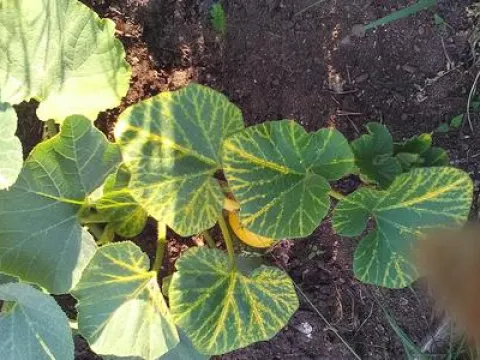
Cucurbit vein yellowing virus
Ipomovirus cucurbitavenaflavi
The disease is caused by the Cucurbit vein yellowing virus (CVYV), which belongs to the genus Ipomovirus within the Potyviridae family. It is a highly significant pathogen affecting various cucurbitaceous crops.
What the section contains
Cucurbit vein yellowing virus
The virus consists of filamentous particles. It is biologically adapted to survive within its primary vector, the whitefly (Bemisia tabaci or similar species), facilitating its spread across agricultural fields.
Transmission occurs exclusively through the feeding activity of whiteflies. The virus is acquired by the insect during sap-feeding on infected plants and is subsequently transmitted to healthy hosts.
Unlike some other plant viruses, CVYV is not transmitted through seeds or mechanical contact during pruning or harvesting. The whitefly vector is essential for the disease cycle to continue.
Host ranges often include weed species surrounding greenhouses, which serve as overwintering reservoirs for the virus until favorable conditions for whitefly activity return.
Early symptoms typically appear on younger leaves as a distinctive clearing or yellowing of the veins. This pattern gradually develops into a widespread, intricate network of chlorotic lines.
As the infection progresses, the entire leaf lamina becomes chlorotic. Infected plants exhibit stunted growth, reduced leaf size, and occasional curling of leaf margins, reflecting a decline in vigor.
Floral and fruit development is heavily impacted. Flowers often abort, and fruits that do manage to develop are frequently distorted, smaller in size, and suffer from poor cosmetic quality.
The entire plant canopy becomes sparse and stunted. Shortened internodes and overall lack of photosynthetic efficiency limit the plant's ability to produce marketable yields.
- Vein clearing on young foliage.
- Network-like yellowing of leaves.
- Stunted plant growth and shortened internodes.
- Fruit deformation and blossom drop.
The development of an epidemic is directly linked to the population density of the whitefly vector. High populations are typical in warm, humid greenhouse environments.
Optimal temperatures for both the host plant and the whitefly promote rapid disease transmission. In the absence of whitefly management, the virus can spread throughout an entire facility within a short period.
Reservoir weed species are critical in maintaining the viral inoculum between planting seasons. Failure to clear weeds around the facility allows the virus to persist and re-infect new crops.
Cultural practices that promote crowding or poor airflow in greenhouses can also favor the accumulation and movement of insect vectors between plants.
Environmental stress on the plants may exacerbate the visual symptoms of the disease, making them more apparent and leading to faster deterioration of the plant's physiological status.
The economic impact of CVYV is substantial due to heavy yield losses. Infected crops often become commercially unviable due to fruit deformity and reduced plant output.
Since there are no curative measures for infected plants, total removal of symptomatic plants is often the only way to manage the spread, resulting in significant loss of investment.
The virus weakens the plants, making them more susceptible to secondary infections or environmental stress, which can lead to premature senescence and death of the crop.
Beyond quantity, the quality of the harvest is compromised, affecting both the physical appearance and potentially the sugar/nutrient content of the fruit.
In high-intensity agricultural systems, an outbreak can lead to the necessity of destroying entire crop cycles, threatening the financial stability of the farm.
Integrated Pest Management (IPM) is crucial. The priority is to maintain rigorous control over whitefly populations using yellow sticky traps and appropriate insecticides.
Sanitary protocols must be strictly followed, including the total removal of weeds around greenhouses and the thorough disinfection of tools and structures between growing cycles.
Chemical control should focus on rotational applications of insecticides to prevent whitefly populations from developing resistance, ensuring higher efficacy of the treatments.
The use of biological control agents, such as predatory insects and parasitoids, can be integrated to manage the vector population while reducing reliance on chemical pesticides.
Implementing physical barriers, such as insect-proof screens on greenhouse vents, is a highly effective preventative measure to exclude the vector from the growing environment.