
Lamium mild mosaic virus
Fabavirus lamii
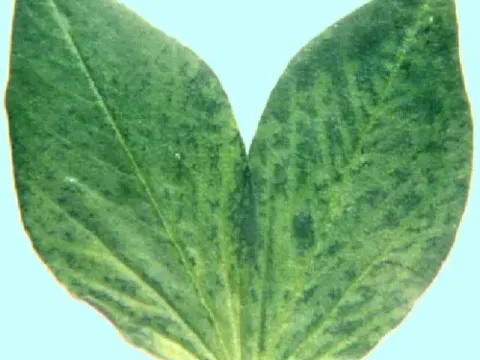
The primary symptom of infection is a characteristic mosaic pattern on the leaves, appearing as alternating light green and dark green areas. Chlorosis of tissues is frequently observed, which may localize along the veins or appear as distinct spotting.
What the section contains
Lamium mild mosaic virus
In severe cases, affected plants exhibit significant stunting and reduced overall development compared to healthy specimens. In some members of the Lamiaceae family, the virus can cause leaf deformation, curling of the margins, or a noticeable reduction in leaf size.
Flowering in infected plants becomes sparse, and the flowers themselves may show abnormal coloration or irregular shapes. Systemic infection leads to premature yellowing and leaf drop of lower foliage, which severely degrades the aesthetic value of the crop.
The intensity of symptoms depends directly on environmental conditions and the plant's physiological state at the time of infection. Symptoms may be more pronounced during cold periods, whereas they might remain latent under optimal temperature conditions.
Visual inspection is often insufficient for a definitive diagnosis, as symptoms can resemble nutrient deficiencies or pest damage. Laboratory diagnosis using ELISA or PCR is recommended to accurately distinguish this from other viral pathogens.
The pathogen responsible for the disease is the Lamium mild mosaic virus, which belongs to the genus Fabavirus in the family Secoviridae. It is a single-stranded RNA virus with spherical virions.
The virus primarily infects plants of the Lamiaceae family, including various species of deadnettle and related ornamental plants. It is known to persist in the overwintering parts of perennial plants.
In field conditions, the virus is primarily transmitted by insect vectors, specifically aphids, which acquire the virus while feeding on infected tissues. Seed transmission is also possible for certain host species, playing a critical role in the primary infection of crops.
The virus is characterized by a high degree of persistence in host tissues, making infected plants a constant source of infection for surrounding crops. Mechanical transmission via garden tools is possible, although less efficient than vector-based transmission.
Studies on the biology of Fabavirus lamii highlight its ability to adapt rapidly to new hosts within closely related botanical groups. Its broad host range within the Lamiaceae family allows the pathogen to persist successfully in various plant communities.
Disease development is most active during periods of high populations of insect vectors that migrate to cultivated crops. Warm and humid weather promotes aphid reproduction, which correlates directly with the increase in infected plants.
The presence of wild Lamiaceae species near the planting area creates a constant reservoir of infection. Infected weeds serve as a starting point for virus spread to cultivated species throughout the growing season.
Weakened plants under environmental stress are more susceptible to viral invasion. Injuries caused by pests facilitate easier penetration of viral particles into the plant's vascular system.
Virus spread in greenhouses can occur more rapidly due to the microclimate favorable for vectors and high planting density. Controlling air humidity and temperature is a key factor in suppressing epiphytotic processes.
Lack of crop rotation and the use of infected planting material are the main risk factors in cultivation. The virus can survive in the rhizomes of perennials, transferring to new shoots in the following season.
The harmfulness of the virus is manifested in a significant reduction in the quality of ornamental or medicinal products. Infected plants lose their market value due to deformed foliage and chlorotic spotting.
Systemic infection suppresses physiological processes, including photosynthesis, which inevitably weakens the plant's immune system. Such specimens become highly vulnerable to secondary fungal and bacterial infections.
Economic losses arise from the need to discard and destroy infected batches of products in nurseries. This leads to direct financial losses and the requirement for extensive area disinfection.
Lamium mild mosaic virus hinders the proper development of the root system, reducing the winter hardiness of perennial crops. As a result, plants often die during the winter period due to the stress accumulated during the growing season.
Overall productivity of seed material obtained from infected plants is significantly below normal levels. Using such seeds for propagation leads to the spread of infection to new planting sites.
The main preventive method is the use of virus-free planting material obtained through tissue culture (meristem tip culture). Only certified material guarantees freedom from dangerous pathogens.
Regular control of insect vectors is necessary, using systemic and contact insecticides. It is important to eliminate aphids before they can spread the virus throughout the entire planting area.
A crucial aspect of protection is the timely removal and destruction (burning) of plants showing mosaic symptoms. Plant debris must be removed from the field, as it can serve as a source of the virus.
Spatial isolation between cultivated crops and wild infection reservoirs is recommended. Regular weeding to remove host plants significantly lowers the infection pressure.
Disinfection of garden tools and containers with a 5-10% sodium hypochlorite solution or other specialized agents after each use is mandatory. These measures minimize the risk of mechanical transmission of the infection.