
Mountain ash ringspot-associated virus
Emaravirus sorbi
The causative agent of the disease is the Emaravirus sorbi, which belongs to the emaravirus group and is responsible for systemic infection within rowan trees.
What the section contains
Mountain ash ringspot-associated virus
The virus is primarily transmitted by eriophyid mites, which act as vectors, feeding on the sap of infected trees and transferring the pathogen to healthy ones.
Another major pathway for transmission is the use of contaminated grafting or propagation material, which often shows no obvious signs of the disease at the time of planting.
Once inside, the virus colonizes the phloem, causing systemic infection that spreads throughout the entire tree, including leaves, stems, and the root system.
The virus exhibits high biological stability, meaning that once a tree is infected, it remains a reservoir for the pathogen throughout its entire lifespan.
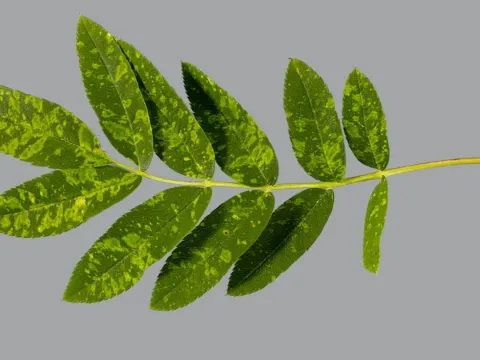
The most distinctive symptom is the development of patterns on the leaves, including light spots, streaks, and bands that create a mottled or "ringspot" appearance.
Leaves often display mosaic patterns with irregular patches of light green, yellow, or pale white, which are most visible under bright, natural light conditions.
In the early stages, infected leaves may show chlorosis (yellowing) and physical deformations, such as curling or crinkling of the leaf blades.
Symptoms are most pronounced during the early spring and early summer, appearing clearly on new shoots and fresh leaves as the tree enters its active growth phase.
The disease causes overall stunted growth, reduced leaf size, and shortened internodes, which give the affected branches a dense, unhealthy appearance.
The virus severely compromises the aesthetic appeal of the trees, which is a major concern for landscape designers and municipal greening projects.
By interfering with the photosynthetic process, the virus limits the tree's energy production, making it significantly more susceptible to environmental stressors.
Infected trees suffer from reduced fruit yield, with berries becoming smaller, less nutritious, and losing their characteristic flavor and quality.
Weakened trees become susceptible to secondary infections, such as fungal or bacterial pathogens, which exploit the tree's diminished immunity.
Over time, the cumulative impact of the virus can lead to the dieback of major limbs and the gradual decline and eventual death of the entire tree.
The primary control measure is the use of high-quality, virus-free planting material sourced from certified nurseries to prevent the initial introduction of the pathogen.
Integrated Pest Management (IPM) practices should be used to control eriophyid mite populations, which are the main carriers of the virus in orchard settings.
Affected trees should be promptly removed and destroyed, including the root system, to eliminate the source of the virus within the immediate environment.
Strict hygiene protocols are essential, including the disinfection of pruning tools with alcohol or appropriate biocides after contact with any suspect plant material.
Establishing spatial isolation between new, healthy plantings and older, potentially infected trees is a recommended strategy for long-term orchard health.