
Morales begomovirus
Begomovirus moralesi
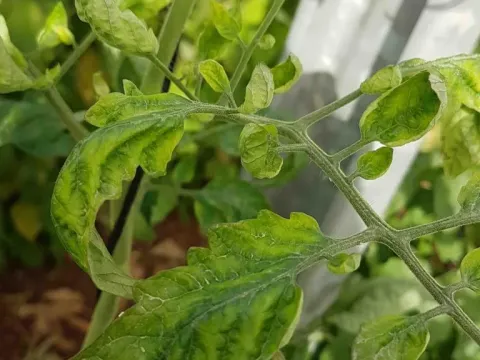
The primary symptom of Morales begomovirus infection is a pronounced mosaic pattern on the leaf blades, often accompanied by chlorotic spots and yellowing. The foliage becomes visibly deformed, curled, and edges may curl upward or downward, hindering normal photosynthetic activity.
What the section contains
Morales begomovirus
Infected plants show significant stunting and physiological growth delays, with shortened internodes giving the plant a dwarf or rosette-like appearance. Flowering processes are severely impaired, and premature dropping of buds and ovaries is a common observation.
Fruit set on infected plants is often undersized, misshapen, and may display discoloration or mottling, rendering them unsuitable for market. The internal tissues of the fruits can lose their texture and nutritional quality.
The virus causes a systemic infection, meaning symptoms appear throughout all levels of the plant's vegetative structure. Leaf vein necrosis is frequently observed and tends to progress as the plant matures.
Visual field diagnosis is challenging due to symptom similarity with nutritional deficiencies or damage from sap-sucking pests. Molecular genetic analysis is recommended for accurate pathogen identification.
The pathogen is a virus belonging to the genus Begomovirus within the Geminiviridae family, characterized by a single-stranded circular DNA genome. This virus has the unique ability to integrate into the host cell's metabolic processes.
In agroecosystems, the primary vector for the infection is the tobacco whitefly, which acquires the virus while feeding on infected plants. Transmission is persistent, meaning the virus remains within the insect for an extended period.
The virus affects a wide range of crops, including Solanaceae family members (tomatoes, peppers) and several legumes. It replicates efficiently within phloem tissues, disrupting the transport of nutrients and sugars.
The pathogen is not transmitted through seeds or via mechanical handling, but its spread is entirely dependent on whitefly population dynamics. The high mutation rate of the virus makes long-term breeding for resistance a complex task.
The biological characteristics of the begomovirus involve hijacking host proteins for its own DNA replication, which suppresses the plant's natural immune response, making disease management particularly difficult.
Virus development is directly correlated with the activity of its primary vector, the whitefly, which thrives in high temperatures (above 25-28 degrees Celsius) and moderate humidity. Massive infestations occur during drought periods.
In greenhouse settings, Morales begomovirus spreads much faster due to the stable microclimate and the lack of natural predators for the whitefly. Greenhouses provide ideal conditions for the virus's year-round cycle.
The presence of alternative host plants, including Solanaceous weeds, allows the virus to persist between seasons. These weeds act as reservoirs for the pathogen in open fields.
The speed of viral transmission increases when spatial isolation between nurseries and commercial plantings is compromised. Migratory whiteflies can travel significant distances on wind currents.
Agronomic factors, such as high-density planting and excessive nitrogen fertilization, create an environment that encourages whitefly population growth, which directly increases the risk of an epidemic.
The main danger of Morales begomovirus lies in massive yield losses, which can reach 80-100% in early-infected crops. Affected plants often become completely sterile.
- Total loss of commercial quality.
- Reduction in nutritional and taste values.
- Death of young plants in the seedling stage.
- Increased costs for insecticide applications.
- Inability to harvest seeds from infected fields.
The virus triggers premature aging and senescence of the leaf tissue, depriving the plant of its energy source. Consequently, photosynthetic activity drops to critical levels.
Economic damage stems from both direct product losses and the indirect costs of vector control. In regions where the virus is prevalent, growing specific crops can become economically unviable.
Long-term persistence of the pathogen in the soil or surrounding ecosystem limits crop rotation options and necessitates strict quarantine measures.
The primary control method is strict management of whitefly populations using modern systemic insecticides. It is critical to rotate chemical classes to prevent the development of insecticide resistance.
Prevention includes using high-quality, virus-free planting material grown in strict isolation from external vectors. The use of insect-proof netting in greenhouses significantly reduces the risk of whitefly entry.
Regular weeding and removal of host weeds around fields and inside greenhouses deprive the virus of its primary reservoirs. Maintaining spatial distance between crops of different ages is mandatory.
Utilizing biological control agents, such as entomophagous insects (predatory mites, parasitic wasps), helps suppress whitefly numbers in the early stages, reducing pesticide reliance.
Breeding for resistant or tolerant hybrids remains the most promising long-term protection strategy. Monitoring for early symptoms and prompt roguing of infected plants help localize outbreaks.