
Morivena spotted wilt virus
Orthotospovirus morivenae
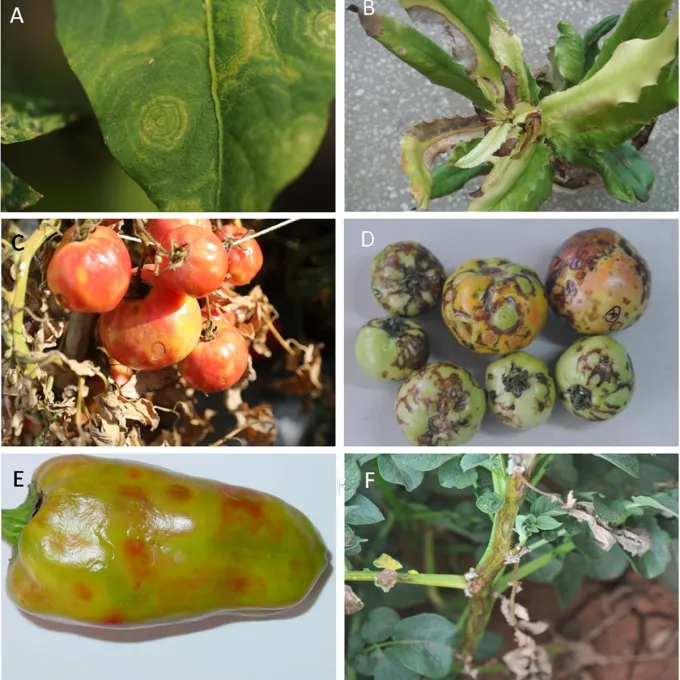
Description
Symptoms
Early symptoms typically manifest as chlorotic spots and ring-like patterns on leaves, which gradually develop into necrotic lesions. The plant growth is significantly stunted and distorted.
Leaves often show mosaic patterns, curling, and crinkling. Systemic necrosis may appear on stems and petioles, which interferes with the plant's ability to transport nutrients and water effectively.
Fruit symptoms include irregular spotting, deformation, and uneven ripening. Such fruit is commercially unacceptable and often leads to total crop loss at the marketplace level.
As the infection progresses, severe wilting occurs, which cannot be corrected by irrigation. This is a hallmark of the systemic nature of the viral infection affecting the plant vascular system.
The severity of symptoms depends on the host plant species, its growth stage at the time of infection, and the environmental conditions prevailing during the growth cycle.
Pathogen
The causative agent of the disease is the Orthotospovirus morivenae virus, which belongs to the genus Orthotospovirus within the Tospoviridae family. This is a highly virulent plant pathogen with a broad host range.
The virus particles are spherical, enveloped, and contain a tripartite single-stranded RNA genome. This structural organization enables the virus to evolve rapidly and overcome plant resistance mechanisms.
Transmission occurs primarily through thrips, which act as vectors. The virus is acquired by larvae during feeding and is then transmitted persistently by adult thrips throughout their lifespan.
Mechanical transmission also occurs in agricultural settings, particularly during pruning, thinning, or harvesting operations where plant sap is transferred between infected and healthy plants.
Long-distance dissemination is often linked to the wind-assisted movement of infected thrips populations, which can introduce the virus into new geographic regions very quickly.
Conditions for development
The virus thrives under warm conditions, with temperatures ranging from 20 to 30 degrees Celsius, which are optimal for the development and activity of thrips vectors.
Weed hosts in the surrounding landscape serve as primary reservoirs for the virus. These reservoirs allow the virus to persist between cropping seasons, ensuring a constant inoculum supply.
High population densities of thrips, combined with low wind exposure in greenhouse environments, facilitate rapid transmission of the virus within the crop canopy.
Short crop rotations and monoculture practices promote the buildup of both the virus and its vector populations in the soil and the immediate vicinity of the fields.
Poor sanitation, such as leaving crop debris after harvest, provides an ideal environment for the virus to survive and spread to subsequent plantings.
Why it matters
The virus causes significant economic damage, with yield losses frequently exceeding 50-70% in susceptible cultivars. It creates substantial challenges for the profitability of commercial farming.
Plants infected by this virus exhibit weakened immune responses, making them highly susceptible to secondary bacterial and fungal infections that further accelerate plant decline.
The reduction in fruit quality and aesthetic value makes the harvest unsaleable, leading to massive financial losses for producers who rely on fresh-market standards.
In cases of early-stage infection, young plants often fail to recover, necessitating extensive replanting and increasing production costs per acre.
The difficulty of detecting early viral symptoms means that by the time a field is diagnosed, the infection is usually widespread, limiting the effectiveness of reactive control measures.
Protection
Integrated Pest Management (IPM) is the primary strategy, focusing on controlling thrips populations using targeted insecticide applications and biological control agents.
Strict sanitation and weed management are essential to eliminate virus reservoirs within and around the growing area. Removing and destroying symptomatic plants is crucial.
Utilizing resistant plant varieties remains the most effective and sustainable long-term method for managing this virus and protecting crop health from potential outbreaks.
In greenhouses, the use of insect-proof netting and monitoring with blue or yellow sticky traps helps in detecting and reducing the vector population effectively.
Maintaining strict quarantine protocols for the movement of transplants and seedlings is vital to prevent the unintentional introduction of the virus into uninfected areas.
Discussion
No discussions yet — be the first.