
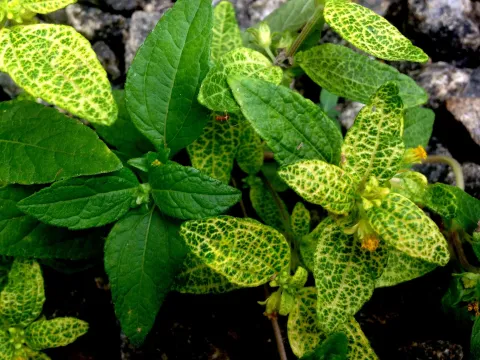
Synedrella yellow mosaic virus
Begomovirus synedrellae
The primary symptom of this disease is the development of a distinct mosaic pattern on the leaves of infected plants.
What the section contains
Synedrella yellow mosaic virus
Leaves often exhibit severe deformation, crinkling, and a significant reduction in size, which impairs the plant's ability to photosynthesize.
Early stages of the infection are characterized by vein yellowing, which eventually progresses into a widespread chlorosis across the entire foliage.
Severe infections lead to extreme stunting of the plant, shortening of internodes, and an overall unhealthy, repressed growth habit.
Reproductive organs such as flowers may fail to develop properly or abscise prematurely, directly impacting fruit set and yield.
The pathogen responsible is a virus belonging to the genus Begomovirus, within the family Geminiviridae, characterized by a single-stranded DNA genome.
As an obligate parasite, the virus requires the internal cellular environment of the host plant to replicate its genetic material.
The disease is primarily transmitted by the silverleaf whitefly Bemisia tabaci, which acquires and inoculates the virus while feeding on plant sap.
The host range is quite broad, including various weed species like Synedrella nodiflora, which acts as a bridge for the virus to enter crop fields.
The virus utilizes the host’s metabolic machinery to propagate, causing systemic infection that spreads throughout the vascular system.
The spread of the virus is highly correlated with the population density of whiteflies, which thrive under hot and arid climatic conditions.
High temperatures accelerate the life cycle of the vector, leading to increased feeding activity and higher rates of virus transmission.
The presence of weeds around agricultural plots provides a crucial reservoir for the virus to survive during the off-season.
Lack of integrated pest management (IPM) allows the whitefly populations to build up, facilitating rapid movement of the virus into commercial crops.
Poor agricultural practices and lack of field sanitation create the ideal environment for the virus to become epidemic.
The economic impact of the virus is significant, as it leads to severe crop failure and drastic reduction in agricultural yield.
The quality of harvested produce is often compromised, rendering it unsuitable for fresh market sale or industrial processing.
Farmers face substantial financial losses due to decreased productivity and the high costs associated with rigorous pest control measures.
Infection during the early seedling stage often leads to the complete death of the crop, resulting in a total loss of investment.
Continuous management of the pathogen increases operational costs and requires ongoing vigilance to prevent reinfection of the plot.
The most effective strategy involves strict sanitation measures, specifically the removal and destruction of weed hosts that harbor the virus.
Managing whitefly populations using targeted systemic insecticides helps disrupt the transmission cycle and reduces the primary spread of the pathogen.
Deploying resistant plant varieties or cultivars is the most sustainable approach to long-term control against begomoviruses.
Implementing cultural practices such as spatial isolation of crops and rotational systems helps reduce the impact of the virus on sensitive cultivars.
- Continuous scouting for whitefly populations.
- Rogueing and destroying symptomatic plants immediately.
- Using insect-proof netting for greenhouse and nursery operations.
- Crop rotation to reduce the build-up of viral inoculum.