
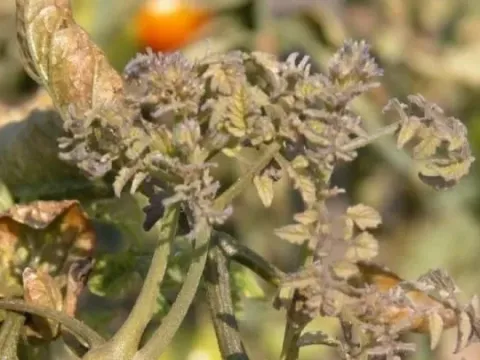
Solanaceous leaf curl virus
Begomovirus solanumphilippinense
The causative agent of the disease is Begomovirus solanumphilippinense, a member of the Geminiviridae family. This virus contains a single-stranded circular DNA genome and is transmitted primarily by insect vectors.
What the section contains
Solanaceous leaf curl virus
The whitefly Bemisia tabaci serves as the primary vector for the transmission of this virus in nature. It follows a persistent circulative transmission mode, where the virus is acquired during feeding and stored in the insect's salivary glands.
Transmission occurs when adults or nymphs feed on healthy plants after having acquired the virus from an infected host. Once infected, the whitefly retains the ability to transmit the virus for the duration of its lifespan.
Beyond tomatoes, the virus affects a wide range of solanaceous crops including peppers and eggplants. Various wild weeds act as asymptomatic reservoirs, maintaining the virus in the environment throughout the growing season.
The biological nature of begomoviruses allows for rapid replication within host plant cells, resulting in systemic infection that affects the vascular system and overall metabolic processes of the plant.
Early symptoms typically manifest as an upward curling of the leaf margins. The leaves eventually thicken, becoming leathery, and often exhibit significant chlorosis or yellowing, particularly along the leaf veins.
Infected plants display a distinct reduction in growth, leading to stunted appearances and shortened internodes. This severe growth restriction is one of the most reliable indicators of infection in the field.
Flowering is often severely impacted, with buds frequently aborting or failing to set fruit. Any fruit that does develop is usually distorted, undersized, and of poor quality, leading to significant commercial losses.
The systemic nature of the virus means that symptoms progress from the point of infection throughout the entire plant. This helps distinguish it from local nutrient deficiencies or physiological imbalances.
- Upward curling and distortion of leaves
- Interveinal chlorosis and yellowing
- Severe stunting and reduced plant height
- Flower abortion and fruit set failure
- Leathery, rigid texture of foliage
The prevalence of the disease is highly correlated with the density of the Bemisia tabaci population. Favorable conditions for the vector, such as high temperatures and stable humidity, facilitate rapid virus dispersal.
In protected cultivation environments, outbreaks occur when greenhouse security is compromised. Failure to manage entry points like vents or doors allows vectors to enter and establish populations on greenhouse crops.
Surrounding weed populations serve as vital primary sources for the virus. Since these weeds often do not show visible symptoms, they provide a continuous pool of inoculum that re-infects neighboring crops.
Transmission can occur at the seedling stage if the nursery environment is not fully protected. Planting infected transplants ensures the rapid establishment and spread of the virus within the main production area.
The timing of infection is a key factor in severity; plants infected at younger stages show more extreme symptoms and suffer greater overall yield reductions compared to those infected later in maturity.
Solanaceous leaf curl virus poses a major threat to agricultural productivity as there is no chemical cure for systemic viral infections. Infected plants serve as sources for further spread, necessitating their removal.
Yield losses can reach 100% in heavily infested areas, rendering the production of susceptible solanaceous crops economically non-viable. High-virulence strains can devastate whole fields in a matter of weeks.
The marketability of remaining fruit is extremely low, as they do not meet consumer standards for size or shape. Furthermore, the weakened state of the plant makes it susceptible to secondary pathogen attacks.
The virus's ability to persist in insect vectors and diverse reservoirs makes it difficult to eradicate once it establishes itself in a region. This makes integrated pest management essential for survival.
Economic impact is compounded by the high cost of intensive insecticide applications. Relying solely on chemical control of the vector is costly and often insufficient once the virus has entered the crop.
Management focuses on rigorous control of the whitefly population using a rotation of insecticides to prevent resistance. Early intervention is crucial to keep the vector pressure below the transmission threshold.
Physical barriers, such as insect-proof netting in greenhouses, are the most effective preventive measures. These barriers prevent the initial entry of vectors, significantly reducing the risk of disease outbreak.
Sanitation practices are vital, including the regular removal of weeds surrounding the fields and the prompt destruction of infected plants to reduce the local virus reservoir for the whitefly population.
Starting with high-quality, virus-free transplants is fundamental. Nurseries must maintain strict isolation protocols and pest-monitoring programs to ensure seedlings remain free from vectors and pathogens.
The development and deployment of virus-resistant or tolerant cultivars remains the most sustainable and efficient strategy. Resistant varieties can maintain productivity even in the presence of the virus.