
Beet leaf curl viroid
Coleviroid betacolei
Description
Symptoms
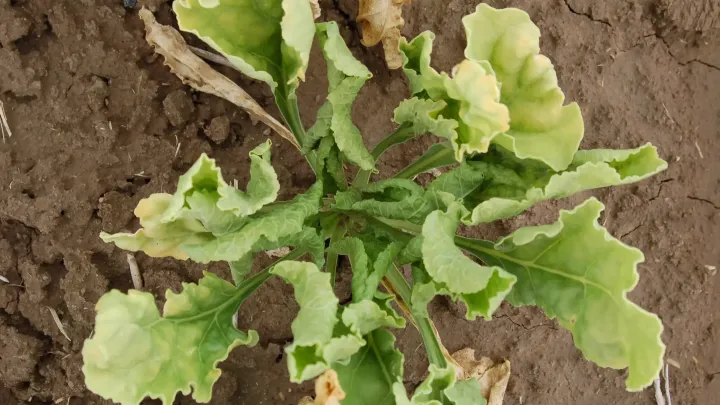
The initial signs involve significant leaf deformation. Leaves exhibit severe curling, often bending downwards, and the leaf surface becomes wrinkled or blistered, which is a classic indicator of the infection.
Interveinal chlorosis is another prominent symptom. The leaf tissue between veins loses its green pigmentation and turns pale or yellow, while the veins themselves often remain green, creating a mottled mosaic pattern.
Infected plants show stunted growth and a general lack of vigor. The leaf rosette becomes dense and stunted, failing to reach the size and architecture typical of a healthy, productive sugar beet plant.
The root system and the taproot itself are negatively affected, resulting in significantly reduced size and weight compared to healthy plants, directly impacting the marketable harvest.
- Leaf deformation and downward curling
- Interveinal chlorosis and mottling
- Stunting and inhibited plant growth
- Reduced root weight and sugar content
Pathogen
The causative agent of the disease is the Beet leaf curl viroid, scientifically known as Coleviroid betacolei. It is a subviral pathogen consisting of a small, circular, single-stranded RNA molecule without a protein capsid.
The viroid relies entirely on the plant's cellular machinery for its replication. By hijacking the host's enzymes, the viroid disrupts metabolic processes, leading to the development of characteristic systemic disease symptoms.
Transmission occurs primarily through mechanical means or via insect vectors, such as aphids or leafhoppers, which ingest the viroid while feeding on sap from infected plants and subsequently inoculate healthy crops.
In the field, the viroid persists in perennial weeds that serve as natural reservoirs during the winter. Infected seeds may also act as a long-distance dispersal mechanism for the pathogen.
The biological nature of Coleviroid betacolei makes it challenging to detect, as the clinical signs can be easily misidentified as environmental stress or nutrient deficiency in the early stages.
Conditions for development
High populations of insect vectors are the primary condition for rapid spread. Warm and dry weather usually encourages the proliferation of aphids and leafhoppers, leading to increased transmission rates.
Poor crop rotation practices and the presence of reservoir hosts, particularly weeds from the Amaranthaceae family, allow the viroid to maintain high inoculum pressure in the environment throughout the season.
Mechanical injuries caused by tillage, thinning, or other field operations create entry points for the viroid. If workers move from infected areas to healthy ones without sanitizing tools, the disease spreads quickly.
Plants subjected to environmental stressors like drought or salinity are physiologically weakened, making them more susceptible to rapid viroid replication once infection has occurred.
Persistent high humidity and rainfall can also facilitate plant-to-plant contact and the movement of the viroid in surface water, especially in dense or poorly managed crop stands.
Why it matters
The primary economic harm is the dramatic reduction in root biomass and sugar accumulation capacity. Infected beets cannot photosynthesize effectively, resulting in lower yields per hectare.
Technological quality of the sugar beet is severely compromised. The internal chemical composition of the root changes, increasing the concentration of non-sugar impurities that interfere with industrial sugar extraction.
Crop loss due to plant death and reduced growth leads to uneven field stands, making mechanical harvesting inefficient and increasing the total cost of production per unit of harvested product.
Viroid-infected plants are more prone to secondary infections by root rot fungi, which significantly complicates storage in warehouses and causes further post-harvest losses.
The presence of the viroid in seed production fields is devastating, as it can cause vertical transmission, leading to a systemic decline in the productivity and vigor of future crop generations.
Protection
The most effective strategy is the use of resistant or tolerant sugar beet varieties. Breeding programs focus on selecting genotypes that suppress viroid replication and tolerate infection without significant yield loss.
Implementing strict spatial isolation between sugar beet fields and potential reservoir crops, combined with aggressive weed control, is essential to minimize the initial infection pressure.
Strategic chemical control of insect vectors using systemic insecticides during the critical stages of early growth can significantly reduce the incidence of primary infections within the crop.
Sanitation of agricultural equipment is vital. Cleaning tools between different fields prevents the mechanical transfer of the viroid, which is a common but often overlooked path of transmission.
Early identification and removal (roguing) of symptomatic plants, followed by their safe removal and destruction, is a proactive measure that can stop the disease from becoming established in a new area.
Discussion
No discussions yet — be the first.