
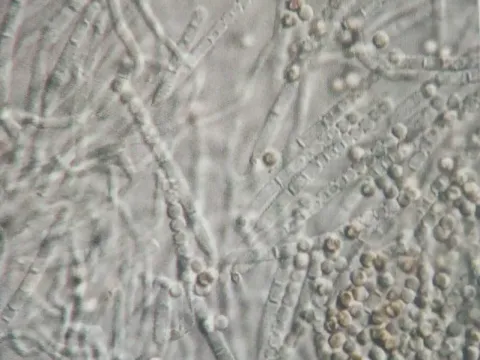
Wallemia
Wallemia
The causative agent of the disease is the microscopic fungus of the genus Wallemia, which belongs to the Basidiomycota phylum. The most significant species involved in agricultural pathology is Wallemia sebi, a well-known xerophilic organism.
What the section contains
Wallemia
These fungi are characterized by their remarkable osmotolerance. They are adapted to thrive in environments with low water activity (Aw), allowing them to colonize substrates that are too dry for most other competitive mold species.
Wallemia biology is defined by the production of abundant, extremely small spores. These spores are easily disseminated by air currents, facilitating rapid spread within warehouses and granaries.
While often considered a secondary colonizer, the fungus actively targets weakened or physiologically stressed plant tissues. In storage settings, it can persist for long periods under minimal nutrient conditions.
Taxonomically, the genus belongs to the Wallemiales order. These fungi are known for their slow growth rates compared to common molds, but they exhibit extreme resilience against harsh environmental stressors including low water availability.
The development of Wallemia is strictly dictated by the moisture levels of the substrate. Unlike typical molds that require high humidity, this fungus prefers dry conditions with low water activity, making it a major risk in stored grains.
Optimal growth temperatures typically range from 20 to 30 degrees Celsius. However, the fungus is highly adaptable and remains metabolically active across a broad spectrum of temperatures found in storage environments.
Improper storage management, such as the formation of condensation due to temperature gradients within grain piles, is the primary trigger for Wallemia outbreaks. Localized moisture hotspots act as initiation sites for colonies.
In field conditions, periods of prolonged drought followed by fluctuating humidity during maturation can predispose crops to colonization. This environmental stress compromises the plant's natural defense mechanisms.
Poor ventilation within storage facilities is a critical factor for proliferation. Stagnant air allows for the accumulation of moisture, creating favorable microclimates on the surface of grain heaps where Wallemia thrives.
The primary impact of Wallemia is the degradation of grain quality. Through the secretion of specific enzymes, the fungus breaks down carbohydrates and proteins, significantly reducing the nutritional value and marketability of the produce.
Infected batches often exhibit a characteristic musty odor and visible surface discoloration. These quality losses make the grain unsuitable for standard processing or livestock feed without further cleaning or treatment.
Reduced seed germination rates are a major economic concern. Crops grown from infected seed material often show poor emergence and stunted development, leading to overall yield losses and potential field failure.
A wide variety of crops can be affected, including wheat, barley, and various legumes. The fungus is particularly hazardous for high-value seed lots intended for long-term storage or international transport.
The presence of Wallemia serves as an indicator of an unstable microclimate. It often precedes and facilitates the growth of more aggressive mycotoxigenic fungi, which can lead to complete spoilage of stored commodities.
Strict moisture management is the cornerstone of control. Keeping the moisture content of stored grains below the critical threshold for xerophilic fungal growth is essential for prevention.
Modern storage facilities must employ active aeration systems to ensure uniform temperature and moisture distribution throughout the grain mass. This prevents the formation of condensation and stagnant moisture pockets.
Treating seeds with broad-spectrum fungicides before storage or sowing provides a reliable defense barrier. This reduces the initial inoculum and protects the seed against early-stage colonization.
Maintaining high sanitary standards in warehouses is vital. Regular cleaning of facilities, equipment, and structural surfaces, combined with antifungal disinfections, keeps the background spore count low.
Regular monitoring of grain moisture and temperature, supported by laboratory diagnostic tests, allows for the early detection of Wallemia. Timely intervention, such as re-drying or cooling, can salvage affected batches.