
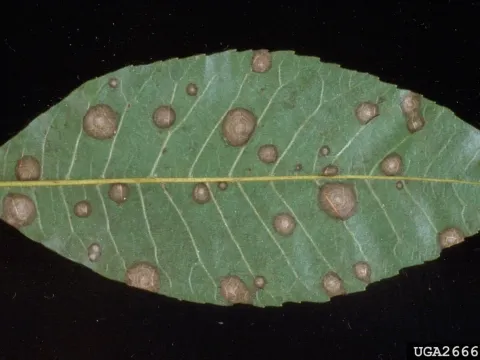
Walnut anthracnose
Gnomonia caryae
The causal agent of walnut anthracnose is the fungus Gnomonia caryae (also known as Ophiognomonia leptostyla in some taxonomic classifications). It is an ascomycete fungus that thrives on walnut trees.
What the section contains
Walnut anthracnose
The pathogen completes its life cycle by overwintering in fallen, infected leaves. During spring, sexual spores (ascospores) are produced in fruiting bodies known as perithecia.
These ascospores are disseminated by wind and rain splashes to newly emerged foliage. Throughout the growing season, the fungus produces asexual conidia, facilitating rapid spread across the canopy.
The fungus invades the leaf tissues through stomata or wounds, spreading its mycelium within the intercellular spaces of the host plant.
The persistence of this pathogen in dead organic matter on the orchard floor makes it a recurring problem that requires consistent management efforts each season.
Early symptoms appear as small, circular, reddish-brown spots on leaves. As the disease develops, these spots expand and often develop a yellow or yellowish-green halo.
In advanced stages, the lesions become irregular or angular in shape and may coalesce, covering large sections of the leaf blade. The center of the spots may turn greyish and become brittle.
The presence of tiny, black, pimple-like structures (acervuli or perithecia) within the necrotic spots on the underside of leaves is the diagnostic feature of this disease.
Severe infections lead to leaf curling, premature yellowing, and early defoliation, which can leave the tree partially bare by mid-summer.
Necrotic lesions can also occur on leaf petioles and young succulent stems, potentially causing shoot dieback and structural weakening.
The disease development is highly dependent on moist conditions. Frequent rain or high humidity levels are essential for spore germination and infection.
Temperatures between 18°C and 25°C are ideal for the rapid growth of the fungus. Extended periods of wet weather during the spring flush are the primary drivers of outbreaks.
Dense canopies with poor air circulation create microclimates that retain moisture, allowing the fungus to thrive even if external weather conditions are somewhat dry.
Orchards that do not practice sanitation and allow leaf litter to accumulate under the trees provide an ideal environment for the fungus to persist from one year to the next.
Water-stressed or nutrient-deficient trees exhibit reduced vigor and defense mechanisms, making them significantly more susceptible to infection by Gnomonia caryae.
Significant loss of leaf area drastically reduces the photosynthetic capacity of the walnut tree, leading to overall decline in growth and vigor.
Premature defoliation prevents the tree from storing adequate carbohydrates for the dormant season, resulting in decreased winter hardiness and bud mortality.
Nut yields are severely impacted, as the trees produce fewer, smaller, and lower-quality nuts compared to healthy trees.
Continuous annual infection weakens the structural integrity of the tree, potentially leading to branch dieback and an increased susceptibility to secondary pests or wood-decay fungi.
The economic impact involves both substantial crop loss and the recurring costs associated with intensive fungicide spray programs needed for control.
Sanitation is the most critical control measure; raking and destroying or deep-burying all fallen leaves in autumn drastically reduces the primary inoculum for the next season.
Pruning trees to open up the canopy improves air circulation and sunlight penetration, which helps keep foliage dry and creates an unfavorable environment for fungal development.
Chemical control involving copper-based fungicides or appropriate systemic treatments should be applied during the early stages of leaf development and when weather conditions favor infection.
Strategic timing of fungicide applications is essential, with an initial protective spray being the most important to prevent the primary spring infection.
- Remove and burn all infected leaf litter during late autumn.
- Thin out the tree canopy to enhance air movement.
- Apply protective fungicides early in the season following local orchard guidelines.