
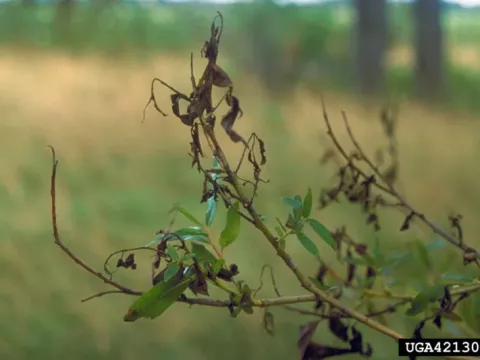
Willow scab
Venturia saliciperda
Willow scab manifests in early spring, typically appearing on young, developing leaves and shoots as small, dark spots.
What the section contains
Willow scab
These spots rapidly enlarge and coalesce, eventually causing the affected leaves to blacken, curl, and fall prematurely from the branches.
Under humid conditions, an olive-black velvety layer develops on the underside of infected leaves, which represents the fungus's conidial sporulation.
Infection on young shoots results in deep lesions and cankers, often leading to the characteristic "shepherd's crook" bending and death of the twig tips.
Severe infestations give the tree a scorched appearance, significantly reducing the visual appeal and overall health of the specimen.
The disease is caused by the ascomycete fungus Venturia saliciperda, a specialized pathogen targeting willow species (Salix).
The fungus overwinters as mycelium and fruiting bodies within fallen leaves and in cankers on twigs that survived the winter.
In the spring, ascospore production is triggered by favorable temperature and moisture, allowing spores to disperse via rain splashes and wind currents.
Once they land on susceptible green tissue, spores germinate and penetrate the epidermis to establish the primary infection site.
Secondary infections occur throughout the growing season as conidia are produced and spread to new foliage during wet weather events.
Willow scab thrives in cool and excessively wet spring weather, which is essential for the germination and spread of fungal spores.
Prolonged rainfall provides the necessary film of water on leaf surfaces, facilitating the penetration of the fungus into the plant tissue.
Densely planted groves with poor air circulation create a microclimate that remains humid, significantly favoring the progression of the disease.
Foggy or misty conditions also provide the extended leaf wetness duration required for successful infection cycles during the summer.
Trees situated in low-lying areas or poorly drained soil are typically more susceptible to outbreaks due to higher local humidity levels.
The extensive loss of foliage due to scab infection inhibits photosynthesis, leading to reduced tree vigor and energy reserves.
Repeated dieback of terminal shoots causes deformity in the branch structure, which can stunt growth and weaken the tree over time.
In landscape architecture, the disease ruins the aesthetic quality of ornamental willows, rendering them unsightly and undesirable.
Chronic infection renders the tree highly susceptible to other opportunistic pathogens, pests, and environmental stressors like drought or frost.
If left unmanaged, the cumulative impact of the disease can eventually lead to the loss of entire branches or the death of the entire tree.
Sanitation is the cornerstone of control; raking and destroying fallen leaves removes the primary inoculum source for the following season.
Pruning out infected branches and cankered wood should be done in dry weather to minimize the risk of spores spreading during the operation.
Improving site conditions by spacing trees appropriately ensures better airflow, which helps foliage dry faster and discourages fungal growth.
Fungicide applications, particularly those containing copper or systemic active ingredients, can protect new growth during critical spring periods.
Timing is vital; initial treatments should commence as soon as buds begin to break, with follow-up applications as dictated by weather patterns.