
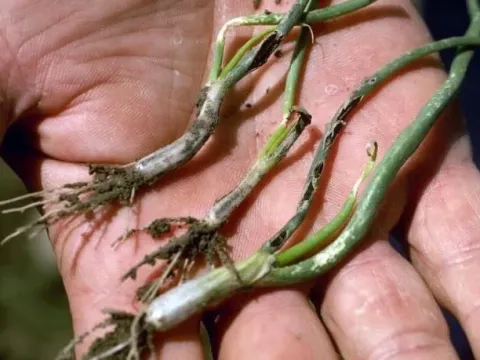
Stem smut
Urocystis
The causative agent of the disease is a group of fungi from the genus Urocystis, with Urocystis occulta being the most prominent species, primarily affecting rye. These are highly specialized pathogens belonging to the basidiomycetes, which persist in the soil and on seeds as spores.
What the section contains
Stem smut
The infection is characterized by the spores' ability to remain viable in the soil for several years. The biological life cycle is closely linked to the seed germination period and the formation of the plant's primary organs.
The fungus develops mainly in the stems, leaf sheaths, and glumes of the affected crop. Within the plant tissues, the parasite forms mycelium, which matures into a mass of spores.
The disease is classified as a systemic infection, where the pathogen progresses through all growth stages of the host plant, starting from the seedling. Transmission occurs both through infected seed material and directly from soil reservoirs.
It is important to note that the biology of the pathogen makes it extremely difficult to detect in the early stages, as until the appearance of visible sporulation, the plant may look indistinguishable from healthy specimens.
The main signs of the infection are longitudinal stripes on stems, leaf sheaths, and leaves. Initially, these appear as light, slightly raised lines that gradually darken over time.
As the fungus matures, the plant's epidermis ruptures, revealing a black, powdery mass of spores. Unlike loose smut, the infection is concentrated primarily on the stems rather than the grain head.
Affected plants are severely stunted, appearing dwarfed, and often fail to produce a normal head. The stems of such specimens become twisted and brittle, which leads to premature lodging.
When inspecting fields during the heading stage, one can notice uneven plant development, with diseased clumps standing out due to their contorted and deformed vegetative parts.
- Black stripes on the stems.
- Deformation and twisting of the straw.
- Epidermal rupture with spore release.
- Stunting and poor tillering.
Stem smut development is favored by cool and moderately moist conditions during the seed germination and seedling emergence stages. The optimal temperature for seedling infection ranges from +5 to +15 degrees Celsius.
Soil with a neutral or slightly alkaline pH favors spore survival. In conditions of a long and cold autumn, the risk of infection in winter cereal crops increases significantly.
Sowing depth plays a critical role: if planted too deep, seedlings remain in the active infection zone of the soil pathogen for longer, increasing susceptibility.
Continuous cropping of susceptible varieties like winter rye on the same fields contributes to the accumulation of inoculum in the crop rotation over several years.
Soil moisture levels above 20% of the field capacity, combined with moderate temperatures, create the ideal environment for the intense spread of the pathogen in the field.
The primary danger of stem smut is a significant reduction in grain yield, which can range from 10% to 50% or more under severe epidemic conditions.
The disease not only reduces grain weight but also causes a sharp decline in quality. Contamination of the harvest with smut spores during threshing necessitates additional cleaning and often renders the grain unsuitable for food processing.
Affected plants have weakened root systems, making them more vulnerable to other diseases and harsh winter conditions, leading to thinning of the crop stand.
Infected stems lose mechanical strength, which provokes lodging, complicating mechanized harvesting and increasing grain losses during the collection process.
The massive accumulation of spores in the soil creates a long-term threat to future rotations, making it difficult to return susceptible crops to previously infected fields.
The primary method of protection is the use of high-quality, treated seed material. Systemic fungicides are effective in destroying the infection both on the surface and inside the seed.
Adherence to crop rotation is mandatory. Returning cereal crops to the same field is only recommended after a 3–4 year break, which helps reduce the infectious load in the soil.
Optimizing sowing dates helps avoid the overlap of the seedling stage with the period of peak pathogen activity in the soil. Timely sowing can significantly lower the risk of infection.
It is recommended to use resistant varieties and hybrids, as selective breeding is key to creating plants with immunity to various strains of this pathogen.
Sowing depth must be strictly maintained according to technical standards to speed up emergence and reduce the vulnerability period of the seedlings.