
Umbilicaria
Umbilicaria
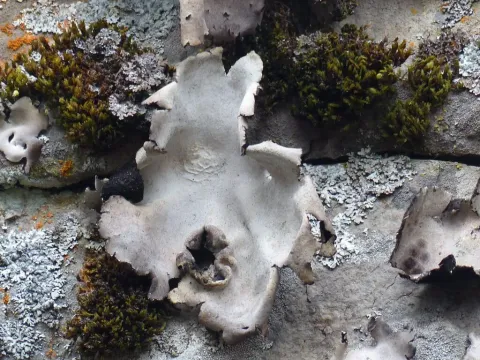
Umbilicaria is a genus of lichen often mistaken for a pathogenic infection on tree bark or rocks due to its specific appearance. The thallus of these lichens is usually foliose, large, and attached to the substrate at a single central point called a gomphus.
What the section contains
Umbilicaria
The appearance of the thallus varies from gray to dark brown or nearly black, depending on the species and light conditions. The surface may be smooth, wrinkled, or covered with distinct outgrowths, which can create a false impression of decay or necrosis on the bark surface.
Upon careful inspection, one can see that the lichen does not penetrate deep into plant tissues but uses the bark merely as a mechanical support. Unlike fungal diseases, Umbilicaria does not damage the cambium or the vascular system of the tree.
On the underside of the thallus, one can often see rhizines — attachment organs that allow the organism to hold onto vertical surfaces. These structures are not related to parasitism on the host plant.
An important identifying feature is the presence of fruiting bodies called apothecia, which appear as black discs or complex fold systems on the plate surface. Their presence confirms that this is an independent symbiotic organism, not a disease.
It is important to emphasize: Umbilicaria is not a plant disease. It is a genus of lichen belonging to the family Umbilicariaceae. This symbiosis consists of a fungal component (mycobiont) and an algal component (photobiont).
Biologically, this organism is an epiphyte that settles on rocks or the bark of old trees. It does not feed on plant sap but obtains essential minerals from precipitation and atmospheric dust.
The mycobiont protects the alga from excessive ultraviolet radiation and dehydration. In turn, the alga, by carrying out photosynthesis, provides the fungus with organic nutrients.
This genus belongs to a group of lichens sensitive to air purity, so their active growth on trees is an indicator of a healthy ecological environment.
Therefore, classifying Umbilicaria as a pathogen for agricultural crops is incorrect, as it exhibits no pathogenic properties toward higher plants.
The development of Umbilicaria requires specific conditions, such as high air humidity and the absence of intensive atmospheric pollution by sulfur dioxide.
These organisms are highly demanding regarding light: they prefer open, well-ventilated areas where there is enough sunlight for the photosynthetic process.
Lichens of this genus are often found at altitudes where temperature regimes are subject to sharp fluctuations, to which they have adapted by entering a state of anabiosis during dry periods.
The growth rates of Umbilicaria are extremely low, requiring a long period of environmental stability for large colonies to form.
The dispersal of the lichen occurs vegetatively through thallus fragments, which are spread by wind or water currents and become attached to suitable surfaces.
Umbilicaria does not cause harm to agricultural crops. It is an indifferent epiphyte that does not compete with trees for nutrients or water.
In exceptional cases, dense colonization of the bark by lichens may slightly hinder the gas exchange of the tree, but this only occurs on very old, weakened specimens where the lichen is secondary.
The agronomic significance of these organisms lies more in their role as bioindicators of environmental quality rather than as a threat to the harvest.
No control measures or specific fungicides are needed to remove Umbilicaria, as it is not a disease.
Removing lichens from the bark of fruit trees may be recommended only for aesthetic reasons or during general sanitary cleaning of the trunks.
No specialized control measures are developed because it is not a pathogen. If the presence of lichens on tree bark is undesirable, general sanitary practices are applied.
An effective method is mechanical cleaning of the bark using stiff brushes, performed during the plant's dormant period to avoid damaging living tissues.
To prevent the colonization of bark by lichens, it is recommended to whitewash the trunks, which creates an unfavorable environment for their attachment.
Proper garden maintenance, including timely pruning to improve canopy airflow, automatically reduces humidity in the trunk area, which inhibits lichen growth.
Using chemical protectants, such as copper sulfate, to combat lichens is impractical, as they pose no threat to the health of cultivated plants.