
Umbilicate lichens
Umbilicariales
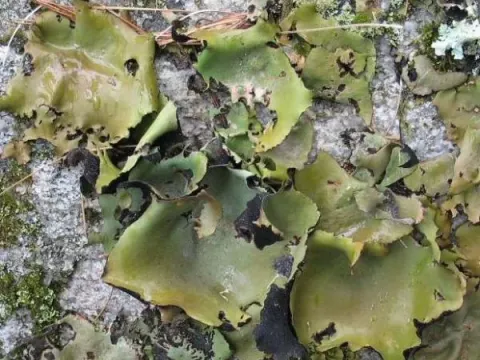
Umbilicate lichens (Umbilicariales) represent a specific group of foliose lichens that grow on various substrates, including the bark of fruit trees.
What the section contains
Umbilicate lichens
It is crucial to clarify that these are not pathogens in the traditional sense; they are symbiotic organisms consisting of fungi and algae.
They act as epiphytes, meaning they use the tree bark merely for physical support without directly feeding on the tree's tissues.
These lichens are taxonomically distinct due to their single attachment point, known as a holdfast or umbilicus, which anchors them to the bark.
While they are natural indicators of air quality, their excessive presence in an agricultural setting is often a sign of poor tree vitality.
The primary symptom is the presence of shield-like or leaf-like growths attached to the trunk and main branches of the tree.
The appearance can range from gray or tan to deep brown, depending on the species and the light exposure on the bark surface.
The characteristic sign is the central point of attachment, which distinguishes these species from other common crustose lichens.
Their texture changes drastically with weather: they appear leathery and brittle during dry spells and become soft and swollen when wet.
Visible colonies are usually concentrated on older bark where the growth cycle has slowed down significantly.
High humidity levels and low light intensity are the most significant factors that encourage the establishment of lichen colonies.
Poorly pruned orchards with dense canopies create the stagnant, moist microclimate required for lichen spore germination and development.
Older trees with weathered, cracked bark are far more susceptible to colonization than young, actively growing trees.
Orchards located in valleys or areas with poor air circulation frequently suffer from higher rates of lichen coverage.
Neglecting standard maintenance practices, such as bark renewal and regular canopy thinning, facilitates their spread.
Massive coverage of lichens can block lenticels on the tree bark, hindering necessary gas exchange and impacting tree respiration.
They provide an excellent protective habitat for various orchard pests, such as scale insects and mites, which hide beneath the lichen layers.
The trapped moisture underneath the lichen can lead to bark decay and increase the risk of secondary fungal infections.
Reduced bark vitality often leads to overall tree stress, resulting in lower fruit yields and weakened immunity against other diseases.
Severe infestations reduce the photosynthetic surface area indirectly by weakening the tree's overall vigor.
Manual cleaning of the trunk and primary branches using specialized scrapers or brushes is the most effective physical control measure.
Applying a lime wash to the trunks during the dormant season acts as a deterrent and cleanses the bark surface.
Routine canopy thinning and pruning improve sunlight penetration and aeration, which are unfavorable conditions for lichen growth.
Copper-based fungicide sprays applied during the dormant phase help eradicate existing spores and prevent new colonization.
- Regular tree vigor monitoring.
- Sanitary pruning for better air circulation.
- Dormant season trunk cleaning and whitewashing.