
Thamnolia vermicularis
Thamnolia vermicularis
Thamnolia vermicularis is a fruticose lichen that is frequently confused with plant diseases due to its unique vermiform appearance.
What the section contains
Thamnolia vermicularis
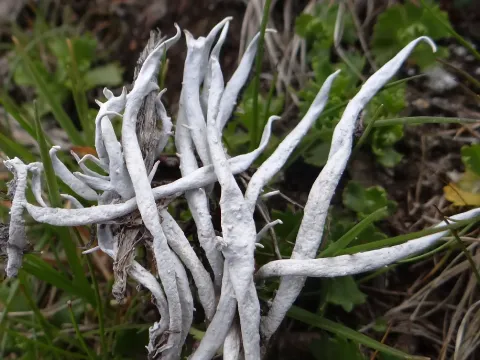
It consists of hollow, elongated, ivory-white or cream-colored thalli that look like worms or small insect larvae scattered on the ground.
The thalli can grow from 2 to 8 centimeters in length, usually appearing singly or in small, loose clusters amidst mosses.
They do not have true leaves, stems, or roots, as they are organisms composed of fungi and algae living in a symbiotic relationship.
Unlike pathogenic fungi that cause lesions on crops, this lichen grows independently on the soil surface without invading plant tissues.
This organism is strictly a lichen, not a pathogen, and it has no biological capability to infect or harm agricultural crops.
It does not possess the enzymes or structural mechanisms required to colonize living plant hosts, meaning it causes no diseases.
The life cycle involves slow growth based on photosynthesis provided by the algal component, completely unrelated to plant parasitism.
Thamnolia vermicularis is an independent organism that utilizes the soil and atmosphere as its primary source of existence.
It cannot be classified as an agricultural threat, as it does not participate in the development of any plant-related pathologies.
The development of Thamnolia vermicularis is restricted to specific, extreme environments such as arctic tundras and high-altitude alpine regions.
It thrives in areas with low atmospheric pollution, high moisture, and low temperatures where plant competition is minimal.
The lichen is highly sensitive to environmental disturbance and agrochemical applications, which effectively prevents its presence in farmland.
It requires stable, long-term ecological conditions to maintain its growth, given its extremely slow metabolic rate.
These organisms are indicators of clean, pristine environments rather than indicators of agricultural distress or poor crop health.
Thamnolia vermicularis causes no harm to agricultural production, as it is a non-parasitic and non-infectious organism.
It does not compete with crops for soil nutrients, minerals, or water, as it relies on atmospheric absorption.
There are no recorded instances where this lichen negatively affected crop growth, harvest yield, or product quality.
It serves no role as a vector for plant viruses or bacteria and does not host pests that damage cultivated species.
The presence of this lichen in a landscape is ecologically neutral regarding the health and management of cultivated plants.
No protection or control measures are required, as this organism does not constitute a disease or a threat to agriculture.
Attempts to eradicate this lichen are unnecessary and scientifically unjustified, as it does not pose any risk to fields or gardens.
Agricultural management plans should treat this organism as a natural component of the local ecosystem rather than a weed or pathogen.
No preventative actions are needed, as there is no infection process to intercept or inhibit regarding the health of crops.
In case of confusion with other fungal growths, farmers should rely on proper identification to avoid unnecessary chemical applications.