
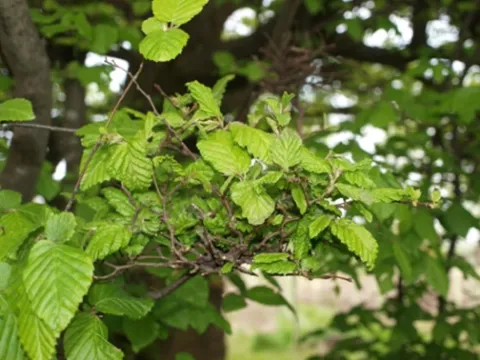
Witches' broom of hornbeam
Taphrina carpini
The causative agent of this disease is the ascomycete fungus Taphrina carpini. It is a highly specialized pathogen that exclusively infects trees of the genus Carpinus (hornbeam).
What the section contains
Witches' broom of hornbeam
The fungus is a parasite that invades the plant tissues, causing localized hypertrophy and hyperplasia. The mycelium is perennial, allowing the pathogen to overwinter inside the tree branches.
During the growing season, the fungus produces a layer of asci (the hymenium) on the surface of the affected organs. These spores are the primary source of spread during the spring.
The life cycle of Taphrina carpini is strictly synchronized with the phenology of the hornbeam. Infection typically occurs in early spring, as buds begin to open, which is the most susceptible phase for the tree.
The spores are dispersed mainly by wind and rain splashes, settling on young buds and shoots to initiate the infection process.
The most distinctive sign is the formation of "witches' brooms". These are dense, stunted, and highly branched clusters of twigs that emerge from a single point, resembling a bundle of sticks.
Leaves on these abnormal shoots are often underdeveloped, curled, and may exhibit chlorosis or reddish discoloration. Their surfaces are typically abnormal, sometimes showing a powdery appearance.
During humid weather, a whitish coating may be visible on the underside of the affected leaves. This represents the fungal sporulation layer, which is a classic diagnostic feature for Taphrina infections.
In winter, after the leaves have fallen, these witches' brooms are very prominent. They appear as thick, distinct clusters of thin, fragile twigs that stand out against the normal branching pattern of the tree.
Over time, the areas where these brooms form may develop localized galls or bark deformations. The tree diverts significant resources to these clusters, which do not contribute to the overall vitality of the plant.
The development of the disease is highly dependent on spring weather. Cool, moist conditions during the critical period of bud break significantly increase the risk of infection.
Dense planting schemes that restrict air circulation are conducive to the spread of the disease. High humidity within the canopy allows spores to germinate more easily on fresh shoots.
The proximity of infected trees acts as a continuous source of inoculum. In areas with high tree density, the disease can spread rapidly through the population if conditions are favorable.
Trees that are already under stress, whether due to drought, poor soil quality, or mechanical injury, are more susceptible to infection and typically show more severe symptoms.
Prolonged spring rains are a key factor in triggering outbreaks. The persistence of moisture on the buds and emerging leaves is necessary for the successful penetration of the fungus.
The disease drains the tree's energy reserves by forcing it to maintain the metabolically demanding but useless witches' brooms. This leads to a general decline in the tree's health.
Severe infections reduce the annual growth increment and can result in the deformation of the canopy. For ornamental specimens, the aesthetic value is significantly diminished.
Photosynthetic capacity is reduced due to leaf deformation and stunted shoot growth. This makes the tree less resilient to environmental stressors like heat or cold.
While the disease is rarely lethal for mature trees, it leads to significant weakening. This predisposes the tree to infestations by secondary pests, such as wood-boring beetles.
In forest ecosystems, the disease hinders the natural regeneration process, as young hornbeam saplings may be severely stunted or killed by the infection before they reach maturity.
The most effective management strategy is the physical removal of the witches' brooms through sanitary pruning. Pruning must be performed well below the point of infection to ensure the fungus is removed.
All pruned material should be destroyed immediately, preferably through burning, to prevent the release of spores. Leaving infected branches on the ground is highly discouraged.
Preventive fungicide sprays, particularly those containing copper, can be applied early in the spring before bud break to provide a protective barrier against spore penetration.
Promoting tree vigor through proper site selection, adequate watering, and mulch application helps trees better resist infections. Avoiding overcrowded planting helps improve ventilation.
- Monitor tree health periodically during the growing season.
- Disinfect all pruning tools with alcohol or a bleach solution between trees.
- Remove any debris or infected parts promptly to maintain orchard or park hygiene.