
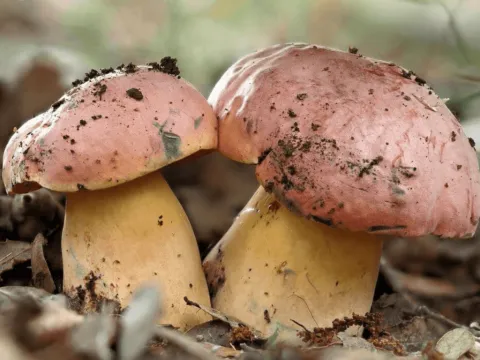
Wolf bolete
Rubroboletus lupinus
The wolf bolete (Latin Rubroboletus lupinus) is a basidiomycete fungus belonging to the Boletaceae family. It is important to clarify that this fungus is not a plant pathogen and does not cause diseases in crops.
What the section contains
Wolf bolete
Biologically, it is a mycorrhizal fungus that forms symbiotic relationships with the roots of broad-leaved trees, such as oaks and beeches. This symbiosis helps trees absorb nutrients and is beneficial for forest health.
The fungus lacks parasitic capabilities and cannot infect agricultural or horticultural crops; therefore, it is of no concern to agronomists.
Its life cycle is entirely dependent on soil conditions and the presence of suitable host trees, with which it maintains a mutually beneficial balance.
Due to its toxic properties and inedibility, the wolf bolete is exclusively a subject of mycological interest rather than an agricultural pest.
The fruiting body is characterized by a large, convex cap with colors ranging from dirty pink to greyish tones. The surface often fades as the mushroom matures.
The pore surface under the cap is distinctively bright red or blood-red, which serves as a key diagnostic feature for distinguishing it from other boletes.
The stem is dense, yellowish, and may have reddish hues or fine reticulation. When cut or bruised, the flesh turns blue almost immediately due to oxidation.
The scent is often described as slightly unpleasant or earthy, especially in mature specimens, differentiating it from the mild scent of edible boletes.
Wolf boletes typically grow in summer and autumn in deciduous forests, preferring calcareous, humus-rich soils.
The primary danger of the wolf bolete is its toxicity to humans. Consumption causes severe gastrointestinal distress, making it an inedible and dangerous species.
Because it does not parasitize crops, it causes no economic loss in agriculture and does not negatively impact crop yields.
The only real harm associated with this fungus is the risk of accidental poisoning due to misidentification during foraging.
There is no impact on plant vigor, metabolism, or structural integrity, as the fungus does not invade living plant tissue.
For individuals, the danger is strictly limited to the accidental ingestion of the fruiting bodies.
No agricultural control measures, such as fungicides or sanitation, are required since this species is not a plant pathogen.
Prevention of risks associated with this fungus is strictly educational, focusing on teaching the public how to identify poisonous mushrooms.
Chemical intervention to eliminate these fungi from soil is unnecessary and potentially harmful to the beneficial soil microflora.
If these mushrooms are found near gardens or orchards, no management or eradication is needed as they pose no threat to the plants.
The most effective strategy is to avoid picking any mushroom if its identification is not certain, especially those that turn blue upon bruising.