
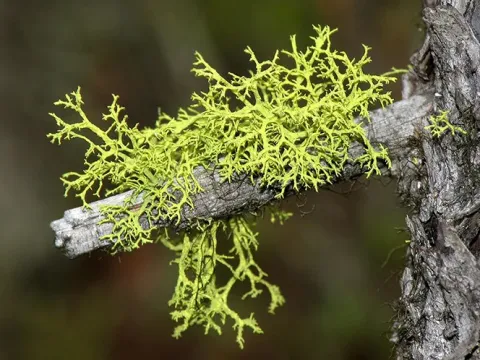
Wolf lichen
Letharia vulpina
Wolf lichen (Letharia vulpina) is a distinctive, bush-like lichen frequently mistaken for a plant disease. It is actually a symbiotic organism composed of fungi and algae living together on the surface of bark or wood.
What the section contains
Wolf lichen
It is strictly an epiphyte, meaning it uses the tree solely as a physical substrate for support. Unlike parasitic pathogens, it does not penetrate the living tissues of the host plant.
Taxonomically, it belongs to the Parmeliaceae family. Its bright yellow or greenish-yellow color is caused by the production of vulpinic acid, which serves as a chemical defense mechanism.
The lichen spreads through spores or small fragments of its thallus being dispersed by the wind. Once they land on a suitable surface, they begin to grow slowly.
It is primarily found on older coniferous trees, particularly larch and pine, favoring environments with high air quality and consistent humidity.
The most obvious sign of wolf lichen is the appearance of bright, sulfur-yellow or neon-yellow bushy structures on the bark of trunks and larger branches.
The thallus is highly branched and may appear tangled, hanging loosely or sticking out from the bark, creating a characteristic appearance on the host tree.
The texture of the lichen is dry and brittle, especially during hot, dry spells, becoming somewhat more flexible after rainfall.
There are no signs of tissue decay, rot, or discoloration of the underlying bark. The bark remains intact regardless of the density of the lichen growth.
Because it requires stable surfaces, the lichen is most prominent on mature, slow-growing trees, often creating a landscape appearance associated with older forests.
The development of Letharia vulpina is heavily dependent on specific environmental conditions, making it an excellent bioindicator of atmospheric health.
It thrives in areas with clean air, as it is highly sensitive to sulfur dioxide pollution, which often kills it before it can establish a large colony.
Cooler, humid climates are ideal for its growth, which is why it is frequently observed in alpine regions or near stable water sources.
The texture of the bark is crucial; older, rougher bark provides more surface area and better anchorage points for the lichen spores.
Moderate levels of light are preferred, allowing for the development of its vibrant yellow pigmentation, which is less intense in deeply shaded areas.
Wolf lichen causes no direct harm to the tree's health. It does not extract sap, nutrients, or water from the tree's vascular system.
While not a disease, a heavy accumulation of lichens may suggest that the tree's bark growth has slowed down significantly, which is normal for older specimens.
Indirectly, the bushy structure can provide a micro-habitat for small insects. While usually harmless, it may occasionally harbor pests seeking shelter from predators.
There is no risk of necrosis or wood rot resulting from the lichen's presence; the bark underneath remains healthy and functional.
The vulpinic acid within the lichen is toxic, making it generally unpalatable to wildlife, which prevents the lichen from being consumed as a food source.
As wolf lichen is not a pathogen, there is no need for chemical treatment or antifungal applications to combat it.
If its presence is undesirable for aesthetic reasons, the lichen can be manually removed using a stiff-bristled brush or a blunt scraper to clear the surface of the bark.
Proper tree care is the best form of management. Ensuring the tree is well-hydrated and adequately fertilized helps it maintain vigorous growth.
Regular pruning to remove dead wood and improve airflow within the crown can help reduce the humidity levels that favor the spread of epiphytes.
While copper-based fungicides used for common fungal infections can inhibit lichen growth, they are generally unnecessary and should not be used solely for this purpose.