
Synalissa
Synalissa
Synalissa is a genus of lichens belonging to the Lichinaceae family. It is crucial to clarify that this organism is not a plant pathogen in the traditional sense, as it does not cause infection or disease within plant tissues.
What the section contains
Synalissa
It is a symbiotic organism comprised of a fungus and cyanobacteria, which allows it to thrive in specific environmental conditions through photosynthesis and nitrogen fixation.
Unlike parasitic fungi, Synalissa does not feed on the tree's sap, nor does it penetrate the bark or wood to derive nutrients.
It primarily utilizes the surface of the bark as an anchor for its growth, effectively functioning as an epiphyte rather than a parasite.
In agronomic science, the presence of Synalissa on orchard trees is categorized as surface colonization rather than an active pathological process.
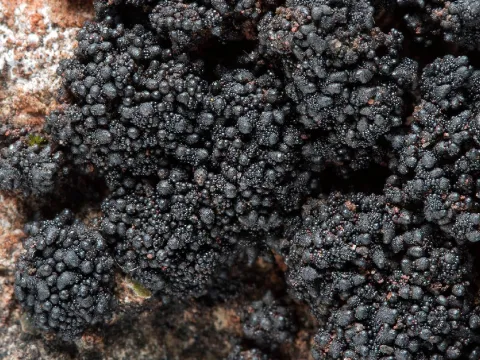
The colonies of Synalissa appear as small, dark, granular, or crusty patches on the surface of tree bark or rock substrates.
When dry, these lichens can be inconspicuous, but they become dark and gelatinous when hydrated by rain or high humidity.
The growth pattern is extremely slow, typically forming dark, blackened spots that contrast with the color of the host bark.
Visible signs often include a textured, scale-like appearance on the trunk, which can become more prominent as the colony expands over several years.
There are no associated necrotic lesions, tissue deformation, or discoloration of leaves that would characterize a systemic disease.
The development of Synalissa is primarily governed by environmental humidity, moisture retention, and light availability within the canopy.
Orchards with dense, unpruned tree crowns create the shaded and humid conditions that favor the establishment of cyanolichens.
Trees with rough, aging bark provide a more stable and favorable surface for lichen attachment compared to the smooth bark of young saplings.
Regions with consistent high humidity and low wind circulation are more prone to the colonization of tree trunks by these organisms.
Poor orchard sanitation, characterized by neglected bark health and lack of maintenance, facilitates the initial colonization by these epiphyte species.
Synalissa causes no direct harm to the metabolic functions of the tree, as it does not compete for minerals or sugars produced by the plant.
However, excessive colonization may provide hiding spots for harmful pests, such as scales or mites, which can use the lichen as a shelter during winter.
Heavy growth on the trunk can potentially impede the natural gaseous exchange of the bark, though this is rarely sufficient to impact tree vigor significantly.
The presence of lichens often serves as an indicator that the tree may be growing slowly or is lacking optimal care and maintenance.
For commercial orchards, the presence of such growth is considered an aesthetic issue and a sign that sanitary pruning and trunk cleaning are overdue.
Effective control involves enhancing tree vigor and maintaining a clean environment within the orchard through proper cultural practices.
Pruning is the primary strategy to improve air circulation and light penetration, effectively removing the habitat conditions favored by lichens.
Mechanical removal of old bark using specialized brushes or scrapers helps to clear the surface of epiphytic growth efficiently.
Applying traditional lime-based whitewash with added copper-based agents is a standard and effective preventive measure against lichen regrowth.
- Regular orchard pruning
- Mechanical cleaning of tree bark
- Maintenance of proper orchard sanitation