
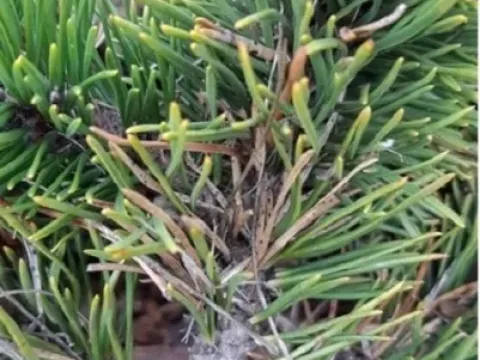
Swiss needle cast
Phaeocryptopus gaeumannii
The primary visual symptom of the disease is the yellowing and premature shedding of needles, which significantly reduces the tree's vitality.
What the section contains
Swiss needle cast
On the underside of the needles, around the stomata, numerous small black fungal fruiting bodies called pseudothecia form, appearing as tiny dots.
Severe infection causes needles to take on a yellow-brown hue, which is particularly noticeable in the lower crown where humidity levels remain higher.
Unlike other needle cast diseases, the foliage may stay on the branches longer in this case, but it loses its photosynthetic capacity.
Affected needles often drop early, leaving the previous years' shoots bare and giving the tree a sparse, unhealthy appearance.
The disease is caused by the microscopic ascomycete fungus Phaeocryptopus gaeumannii, which is a known pathogen of coniferous tree species.
The pathogen is highly specialized and affects only plants of the Pseudotsuga genus, particularly the widely planted Douglas-fir.
The fungus develops primarily within the needles' stomata, where it produces fruiting bodies that block gas exchange and hinder the plant's respiration.
Fungal mycelium penetrates deep into the needle tissue, extracting nutrients and gradually destroying the internal structure of the foliage.
Spore dispersal occurs mainly through wind currents and rain splashes during the spring and summer, when environmental conditions are most favorable.
Infection development is favored by high relative humidity and moderate temperatures, which are optimal for fungal spore germination.
The disease spreads most actively in dense, poorly ventilated plantations where moisture lingers on the needle surfaces for extended periods.
Prolonged rainy seasons and fog during the peak growth period significantly increase the risk of mass infection in both saplings and mature trees.
Poor agricultural practices, such as overly dense planting schemes, create a microclimate ideal for the rapid reproduction cycle of the fungus.
It has been established that host susceptibility can depend on the genetic predisposition of specific Douglas-fir populations to this infection.
The primary danger of Swiss needle cast is the gradual weakening of trees due to the constant loss of a significant portion of their assimilation apparatus.
Chronic infestation leads to reduced growth rates and a decrease in annual wood increment, which is critical for forestry production.
In nurseries, the disease can cause mass mortality of young seedlings, resulting in serious economic losses for commercial growers.
Trees that are chronically infected by this fungus become more susceptible to secondary pests, such as bark beetles or wood-decaying organisms.
In ornamental horticulture, affected trees lose their aesthetic appeal, making them unsuitable for landscaping and urban design purposes.
The most critical preventive measure is the selection of high-quality planting stock that shows resistance to fungal infections.
Avoiding overly dense planting is essential to maintain optimal airflow, which prevents excessive moisture accumulation on the needles.
Sanitary pruning and the timely removal of infected branches help reduce the overall inoculum load within a forest stand or site.
The application of copper-based fungicides or systemic chemical treatments is effective during the peak spore dispersal periods in spring and early summer.
- Regular monitoring of canopy health
- Timely thinning of dense plantations
- Application of approved fungicides
- Sanitation by removing infected debris