
Mediterranean Suillus
Suillus mediterraneensis
Suillus mediterraneensis is a mycorrhizal fungus belonging to the Boletaceae family. It is not a plant disease, but rather a vital symbiotic partner for various pine species.
What the section contains
Mediterranean Suillus
The fungus interacts with tree roots through ectomycorrhizae, facilitating nutrient exchange between the fungal network and the host tree's root system.
This symbiotic relationship is essential for the growth and vitality of pine forests, especially in nutrient-poor soils characteristic of the Mediterranean region.
Mycology studies categorize this fungus as a beneficial organism, ensuring the health and resilience of the coniferous forest ecosystems it inhabits.
Understanding its biological role helps forest managers maintain ecological balance and improve forest productivity in dry Mediterranean climates.
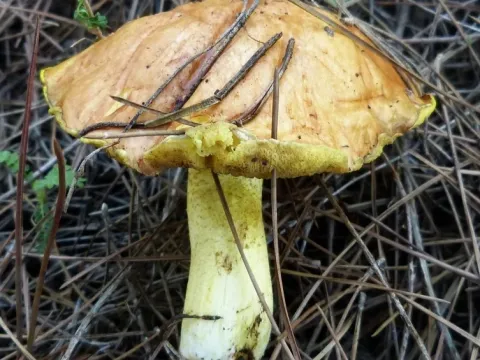
The mushroom features a convex or flat cap measuring up to 12 cm in diameter, typically ochre-brown and often slimy under humid weather conditions.
The spore-bearing surface is composed of yellow tubes, which transition to an olive-brown hue as the fungal spores reach full maturity.
The stem is robust and cylindrical, marked with distinctive reddish or brownish spots, and notably lacks a ring (annulus) around the stalk.
The flesh is firm and remains yellowish when sliced, a key diagnostic feature used to differentiate it from other related Suillus species.
The presence of this fungus is usually observed through clusters of fruiting bodies appearing in pine stands after significant rainfall events.
The species is primarily distributed across Mediterranean regions, thriving in mild, maritime-influenced climates with specific rainfall patterns.
It exclusively associates with specific pine species, such as Pinus halepensis and Pinus pinea, defining its ecological niche.
Preferred soil types include sandy or calcareous substrates that provide excellent drainage, preventing waterlogging of the fungal mycelium.
The developmental cycle is strongly tied to the Mediterranean autumn, requiring consistent moisture to initiate the formation of visible fruiting bodies.
During the dry summer months, the fungal mycelium survives in the soil under pine litter, waiting for favorable moisture conditions to emerge again.