
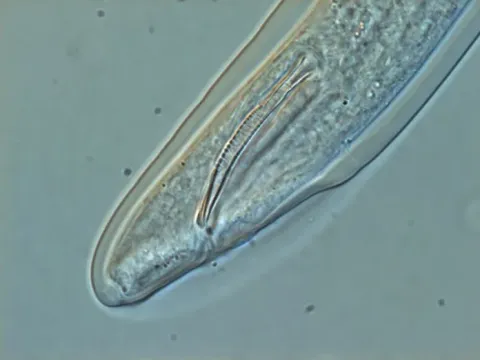
Paratrichodorus minor
Paratrichodorus minor
Paratrichodorus minor is a species of ectoparasitic nematode that lives in the soil and damages plants by feeding on their root systems.
What the section contains
Paratrichodorus minor
As a highly efficient polyphagous pest, it attacks a wide variety of plants, including potatoes, celery, alfalfa, beans, cocoa, citrus, and ornamental plants like Gerbera jamesonii.
Unlike endoparasitic nematodes, it remains outside the roots, using a specialized stylet to puncture and feed on the surface cells of the root tips.
Beyond direct feeding damage, it is a significant vector for several plant viruses, most notably the Tobacco Rattle Virus (TRV), which causes severe economic loss.
The dissemination of this pathogen occurs through contaminated soil movement, infected seedlings, agricultural machinery, and irrigation water flow.
The visible symptoms of infestation are often non-specific, characterized by stunted growth, chlorosis, and wilting during the hottest parts of the day.
When examining the root system, one can observe the "stubby root" appearance, where root tips are thickened, shortened, and necrotic, hindering proper nutrient uptake.
In potatoes, the viral transmission linked to this nematode causes corky ringspot disease, resulting in brown arcs, rings, or spots inside the tuber flesh.
Celery and other leafy greens exhibit reduced vigor, yellowing leaves, and significant yield reduction due to the lack of a functional root system to support plant mass.
Field manifestations appear in irregular patches where crop development is noticeably uneven compared to surrounding healthy plants.
Paratrichodorus minor thrives in sandy and sandy-loam soils, which allow for easier movement of the nematodes through soil pores and water films.
Soil moisture is the most critical environmental factor; high humidity levels following irrigation or rainfall significantly increase the activity and mobility of the nematode.
Optimal growth and reproduction occur at soil temperatures between 15°C and 25°C, making the growing season a prime window for crop damage.
The absence of crop rotation allows populations of these nematodes to build up to damaging levels over consecutive planting seasons.
Poorly drained or excessively acidic soil conditions can occasionally influence population dynamics, though host availability remains the primary driver.
Direct damage involves the destruction of root meristems, which significantly impairs the plant's ability to absorb water and essential minerals from the soil.
The indirect harm caused by the transmission of plant viruses leads to chronic infections that can ruin the quality and marketability of the entire harvest.
Commercial losses are particularly high in potato farming, where internal tuber necrosis renders the product unfit for retail and processing standards.
Ornamental production suffers from quality loss, as the weakened roots lead to flowers that lack uniform size and vibrant color, reducing their value.
Stressed plants become more susceptible to other soil-borne pathogens and environmental factors, leading to a synergistic decline in field productivity.
The primary control strategy is the use of nematode-free planting material, which prevents the introduction of the pathogen into clean fields.
Implementing strict crop rotation programs, alternating between host and non-host crops, helps keep nematode populations below the economic threshold.
Soil fumigation before planting is a common professional practice for high-value crops, though it must be conducted under strict environmental and safety guidelines.
Rigorous sanitation of equipment and machinery is essential to prevent the transfer of infested soil between different agricultural areas.
Healthy soil management, including the addition of organic matter and maintaining optimal plant vigor, allows crops to better tolerate the feeding pressure of nematodes.