
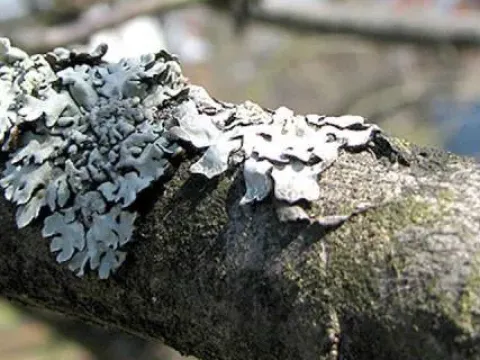
Parmeliaceae lichens
Parmeliaceae
Parmeliaceae lichens are a family of symbiotic organisms consisting of fungi and algae that exist as epiphytes on the surface of tree bark. They do not feed on the plant tissues but utilize the bark as a stable anchor.
What the section contains
Parmeliaceae lichens
The spread of these organisms is initiated by spores dispersed by wind or water droplets, which settle in the crevices of the bark and begin to develop thalli.
These lichens have a foliose or crustose structure that adheres firmly to the substrate. As they grow, they form intricate rosettes or patches that can cover extensive areas of the trunk and branches.
Biologically, they are highly resilient, able to survive in harsh conditions by entering a state of dormancy during dry periods and activating during rainfall.
They are frequently found in mature orchards, particularly on species with dense or rough bark, serving as a sign of environmental air quality.
The primary symptom is the appearance of flat, leaf-like patches on the bark, which can range from light gray to greenish-yellow or brown.
The thallus of the lichen may feel soft and pliable when moist, but it turns brittle and flaky during prolonged periods of dry weather.
Clusters of lichens often develop in a radial pattern, expanding outward from a central point as the colony matures and ages.
The bark beneath well-established lichen colonies often appears discolored, damp, or structurally altered compared to clean areas of the tree trunk.
In advanced cases, the bark surface may become uneven or cracked, providing even more surface area for lichen attachment and moisture retention.
High humidity and poor air circulation are the most significant factors promoting the rapid colonization of tree surfaces by Parmeliaceae.
Neglected orchards with unpruned, dense crowns prevent sunlight from reaching inner branches, creating the damp, shaded microclimate that these lichens thrive in.
Older trees are significantly more susceptible due to their naturally rougher, more porous bark, which provides a better mechanical grip for spores.
Low levels of air pollution allow these lichens to flourish, as they are highly sensitive to sulfur dioxide and other chemical pollutants common in industrial areas.
Inadequate orchard sanitation, specifically the lack of trunk maintenance, allows lichen spores to accumulate and spread across the entire canopy over several growing seasons.
Lichens act as a physical barrier that restricts the normal exchange of gases between the bark and the atmosphere, potentially reducing the vitality of the tree.
They create a micro-habitat that serves as a reservoir for harmful pests like scale insects and mites, which can easily hide underneath the lichen layers.
The constant moisture trapped by the lichen can lead to the softening and premature degradation of the bark, creating entry points for secondary fungal diseases.
Large lichen populations are often correlated with a decline in tree vigor, contributing to reduced fruit quality and decreased overall yield in the orchard.
The presence of dense lichen cover is often a secondary symptom of a tree that is already under stress or suffering from overall neglect in its maintenance.
Mechanical removal using stiff brushes or wooden scrapers is the most effective way to clear trunks and branches during the dormant winter season.
Whitewashing tree trunks with lime solution fortified with copper sulfate helps to sterilize the bark and prevents new lichen spores from attaching.
Proper pruning practices are essential to open up the canopy, improving airflow and light penetration, which makes the tree environment less hospitable to lichens.
Spraying trees with a 3–5% solution of ferrous sulfate is a proven method to effectively control lichen growth without causing damage to the healthy bark of the tree.
- Regular monitoring of tree bark during early spring and late autumn.
- Maintaining optimal soil nutrition to boost the tree's internal defense mechanisms.
- Removing debris and weeds around the base to lower humidity levels in the orchard.