
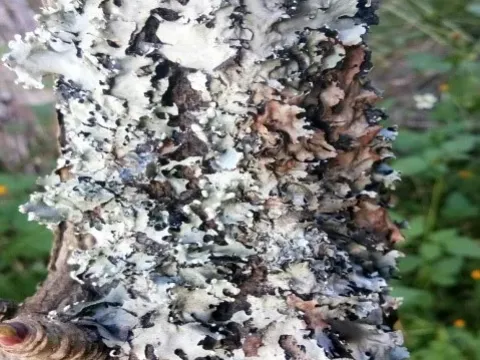
Parmelia
Parmelia
Parmelia is a genus of foliose lichens commonly found on the bark of trees. It is a symbiotic organism comprising a fungus and an alga, meaning it does not act as a traditional plant pathogen.
What the section contains
Parmelia
The lichen does not feed on the tree's sap or nutrients. Instead, it uses the bark surface solely as a physical substrate for anchoring, relying on rainfall, dust, and sunlight for its own metabolic needs.
Its thallus (the main body) typically forms flat, leafy, or scale-like structures. These can vary in color from pale grey to brownish-grey depending on environmental conditions.
Parmelia is highly resilient to harsh conditions. It can enter a dormant state during periods of drought, effectively suspending its metabolism until moisture returns to the environment.
Spread occurs primarily through spores or fragmented parts of the thallus, which are easily transported by wind or raindrops onto nearby branches or adjacent trees.
The visual presence of Parmelia is marked by flat, irregular patches of grey or brown scales adhered firmly to the tree trunk or thicker branches.
It prefers shaded or semi-shaded areas, such as the lower portions of tree trunks or dense branch junctions where moisture lingers for longer periods.
Over time, these patches can expand and coalesce into large colonies, creating a textured, almost mosaic-like crust that covers significant portions of the tree's bark.
On older trees, the bark beneath heavy lichen colonies may appear softened or damp. In severe cases, the lichen can cause the outer layers of the bark to peel away prematurely.
While the lichen itself is not an active disease, its dense coverage creates a physical barrier that alters the visual appearance and surface texture of the tree.
Parmelia thrives in environments with high humidity and poor air circulation. Densely branched trees with thick foliage create a microclimate that is ideal for lichen colonization.
Because lichens are sensitive to air pollutants, their abundance often reflects relatively clean air, but it also signals a lack of maintenance and pruning in the affected orchard or landscape.
Older trees with rougher, more fractured bark are more susceptible to Parmelia, as the texture provides better anchor points for spores to settle and germinate compared to smooth young bark.
Inadequate orchard management, such as poor drainage or excessive overhead watering, can increase localized humidity, providing the perfect conditions for Parmelia to expand.
A lack of regular sanitation means that once the lichen becomes established, it can spread unchecked for years, gradually increasing its coverage area across the wood.
The primary concern regarding Parmelia is that dense colonization interferes with bark respiration. By creating an airtight seal over the bark, it restricts gas exchange, which can hamper the tree's physiological processes.
The thick layers of lichen serve as a refuge for various orchard pests, such as scale insects, mites, and their eggs, providing them with protection against natural predators and chemical treatments.
Persistent moisture held by the lichen layer can promote rot or secondary fungal infections, which may eventually damage the tree's vital outer tissues.
While often a symptom rather than a primary cause, heavy lichen growth is associated with tree decline. Trees heavily covered in Parmelia often show reduced growth rates and diminished vitality.
In winter, excess moisture trapped by the lichen may contribute to localized frost damage on the bark, as the damp material can freeze and create temperature fluctuations.
The most effective management strategy is manual removal. During the tree's dormant season, use a dull scraper or a stiff brush to carefully remove the lichen colonies without damaging the healthy bark tissue beneath.
After mechanical cleaning, it is recommended to sanitize the bark using a 3-5% iron sulfate solution. This helps to eliminate any remaining spores and prevents the lichen from recolonizing the area.
Proper pruning is essential to improve airflow and light penetration within the canopy. A well-pruned tree is much less hospitable to lichens than a dense, neglected one.
- Prune trees to open up the canopy for better ventilation
- Mechanically remove lichen during the dormant season
- Apply a lime wash with copper-based additives to the trunk
- Maintain tree vigor through proper fertilization and watering
Preventative white-washing of trunks using lime mixed with copper-based fungicides creates a surface environment that is highly unfavorable for spore settlement, effectively protecting the bark.