
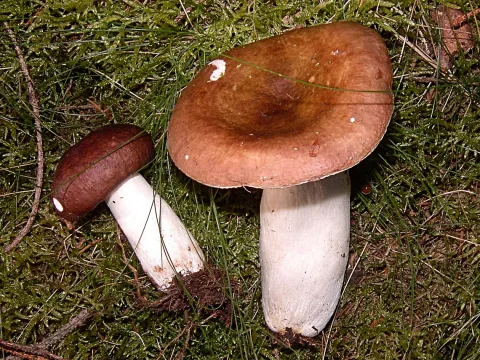
Russula integra
Russula integra
Russula integra (commonly known as the entire brittlegill) is not a plant pathogen affecting agricultural crops, but a beneficial member of the Russulaceae family.
What the section contains
Russula integra
In agronomy and mycology, this organism is categorized as a mycorrhizal symbiont, establishing stable and mutually beneficial relationships with the root systems of various tree species.
Biologically, it is a fleshy macrofungus with a lamellar hymenophore, possessing absolutely no parasitic capabilities toward crops, vegetables, or field plants.
Its primary ecological function is the exchange of minerals and nutrients between the mycelium and the tree roots, which supports the healthy development of forest ecosystems.
As it is not an infectious agent, this species does not require any pest control measures, fungicides, or specific phytosanitary interventions.
The fruit bodies of Russula integra exhibit a diverse range of cap colors, including dark brown, purple, and reddish hues, often with a paler margin.
The surface of the cap is typically dry and matte; the cuticle is separable only at the margins of the cap, which is a key diagnostic feature for the species.
The gills are initially white in young specimens but turn a characteristic ochre-yellow color as the spores mature and deposit upon the lamellae.
The stipe (stem) is robust, white or slightly yellowish, and cylindrical, lacking any remnants of a veil, such as a ring or a volva, characteristic of the genus.
The spore print is distinctly ochre, which serves as a reliable taxonomic indicator to distinguish this species from other Russula members with white spore prints.
The main condition for the successful growth of Russula integra is the presence of mature forest stands, which provide the necessary substrate for mycorrhizal formation.
This fungus favors moist soils with an acidic to neutral pH, rich in organic matter and leaf litter, which provides a balanced nutritional environment.
Optimal temperatures for fruit body development range from 15 to 22 degrees Celsius, provided that there is sufficient humidity in the soil and air.
Unlike invasive plant pathogens, this fungus cannot survive in cultivated fields due to its high sensitivity to frequent mechanical soil disturbance and tillage.
The mass fruiting period occurs during the late summer and autumn seasons, triggered by regular rainfall and consistent environmental moisture levels.
From the perspective of plant protection and crop management, Russula integra poses no threat to agriculture, orchards, or horticultural production.
The species lacks the enzymatic pathways required to degrade the living tissues of agricultural plants, as it is specialized for symbiotic mycorrhizal interaction.
In forestry, the presence of such fungi is often viewed positively, as it enhances the nutrient uptake of trees and strengthens their overall biological resilience.
The species is not listed as a pest or a disease agent in any agricultural register, and it has no economic impact on food security or crop yields.
Consequently, no management or protective measures are necessary, as the mushroom functions as a natural component of forest health rather than a crop disease.