
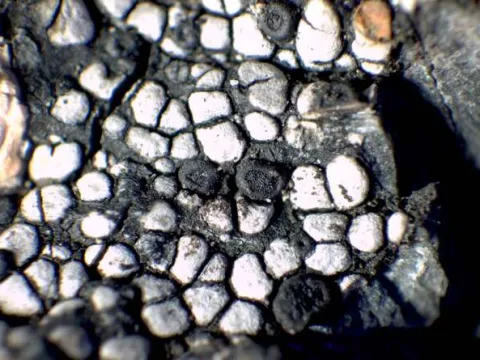
Rhizocarpon geminatum
Rhizocarpon geminatum
Rhizocarpon geminatum is a crustose lichen that is firmly attached to its substrate, usually stone or rock surfaces.
What the section contains
Rhizocarpon geminatum
The thallus is typically grayish or yellowish-grey, with a cracked appearance that often resembles a map.
It features prominent black apothecia, which are fruiting bodies often sunken within the lichen's body.
Unlike fungal plant diseases, there are no visible lesions, necrotic tissues, or mycelial growth on nearby plants.
It maintains a static position on the substrate and does not spread to vegetation, as it is strictly lithophilic.
This organism is not a plant disease and does not act as a pathogen for any agricultural or horticultural crops.
It is a symbiotic association between a fungus and an alga, functioning as a primary colonizer of hard, mineral surfaces.
The species lacks the biological mechanisms to invade plant cells, consume plant nutrients, or cause host-specific damage.
It is strictly classified within the group of lichens and is studied in the field of lichenology, not plant pathology.
Consequently, it does not interact with the biological cycles of cultivated plants in any negative capacity.
The lichen thrives in open, sunny environments where it is exposed to ambient moisture and clear air.
It is a slow-growing organism that requires stable, inorganic surfaces like rocks, stone walls, or concrete structures.
Growth is inhibited in areas with high levels of pollution, as the species is sensitive to air quality.
It survives in harsh temperature regimes where vascular plants would struggle to establish themselves.
Dispersal occurs via spores which require specific environmental conditions for successful colonization of new rock surfaces.
There is no measurable economic harm or damage caused by Rhizocarpon geminatum to agricultural production.
It does not cause yield losses, quality degradation, or the spread of any infectious plant agents.
The lichen is completely benign concerning plant health, field operations, and crop storage practices.
No agricultural risks are associated with its presence, and it does not deplete soil fertility or water resources.
In a farming context, it is merely a part of the local microflora on inert objects rather than a concern for the agronomist.
No protection measures are required or recommended for this species, as it poses no threat to crops.
Mechanical cleaning or pressure washing may be employed if the removal from building surfaces is desired for aesthetic reasons.
Fungicides should never be applied against this species, as they would be ineffective and unnecessary for a non-pathogenic lichen.
Environmental management, such as reducing moisture on building exteriors, can limit the growth of lichen where it is not wanted.
Regular maintenance of infrastructure and keeping non-crop surfaces clean is sufficient to manage its distribution on a farm site.