
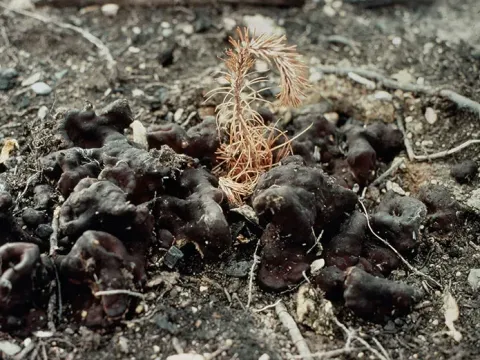
Rhizina root rot
Rhizina
The disease is caused by the ascomycete fungus Rhizina undulata. It is a soil-borne pathogen that primarily lives as a saprotroph on woody debris but can aggressively parasitize the roots of living conifers under specific environmental stimuli.
What the section contains
Rhizina root rot
The life cycle of the fungus is strictly dependent on the availability of organic matter, particularly stumps and roots remaining after harvesting or fire. The mycelium spreads through the soil to reach the root systems of healthy trees.
Reproduction occurs via spores that are wind-dispersed over vast areas. These spores can remain dormant in the soil for several years until they encounter conditions that trigger their germination.
The mycelium of Rhizina undulata grows rapidly in moist soil. It penetrates the host's root system through mechanical wounds, eventually causing the destruction of the cambium and xylem tissues.
As the fungus colonizes the root system, it disrupts water and nutrient uptake, leading to the systemic decline of the host tree, which is irreversible once the infection reaches the root collar.
The earliest symptom of the infection is the yellowing of needles, which quickly transitions into a reddish-brown color. This chlorosis typically starts from the lower branches and moves upward toward the top of the tree.
Upon inspecting the root collar, one can find white to yellowish mycelial mats between the bark and the wood. The bark in the infected area becomes soft, spongy, and may produce a distinct mushroom-like odor.
The presence of Rhizina undulata fruit bodies near the tree base is a diagnostic feature. These appear as irregular, undulating, or wavy disks ranging from dark brown to reddish in color, tightly attached to the soil surface.
In young plantations, the progression of the disease is very rapid. Tree mortality often occurs within a single growing season, leading to sudden, patchy death across the site.
The appearance of "dead patches" or circular gaps in a conifer stand is a classic indicator that a colony of Rhizina undulata has established itself in the soil.
The primary trigger for the development of Rhizina root rot is the heating of the soil. This is most common following controlled burning or wildfires, as heat shocks the dormant spores into rapid germination.
High soil moisture is essential for the vegetative growth of the mycelium. Outbreaks are most frequent in areas with poor drainage or during seasons characterized by excessive and prolonged precipitation.
Root contact between trees in dense plantations facilitates the spread of the fungus. As the mycelium grows along the root surfaces, it easily infects adjacent healthy trees, creating expanding centers of infection.
The presence of stumps left behind after logging provides a massive substrate for the pathogen to thrive and accumulate inoculum levels that can sustain an epidemic for many years.
Environmental stress, such as drought followed by waterlogging, can weaken the natural defense mechanisms of conifer seedlings, making them more susceptible to the initial infection.
Rhizina root rot is a devastating disease for conifer forestry, causing significant financial losses due to the destruction of young stands. It is particularly dangerous in newly replanted areas.
Beyond the immediate loss of timber, the disease degrades the site quality. Replanting trees in infected areas often results in repeated failures, as the pathogen remains viable in the soil for an extended period.
The loss of forest cover increases the risk of soil erosion and negatively impacts the local biodiversity. The collapse of the tree canopy alters the microclimate of the affected area.
Affected trees are highly vulnerable to secondary pests, including various species of bark beetles and wood-boring insects, which further complicate the management of the stand.
The long-term presence of the fungus in the soil necessitates strict quarantine and site management practices to prevent the infection from spreading to adjacent healthy forest blocks.
The most effective strategy for managing Rhizina root rot is the thorough removal of stumps and roots from the site before replanting. Eliminating the primary food source prevents the build-up of the fungus.
Preventing fires on reforestation sites is crucial, as the heat pulse from burning slash or fire is a known catalyst for the germination of Rhizina spores.
Once an infection center is identified, the area should be isolated by digging deep trenches (50-60 cm) around the infected group to stop the spread of mycelium via root-to-root contact.
Monitoring the health of young plantations is essential. Any tree showing early symptoms should be carefully removed, ensuring the entire root system is taken out of the soil.
- Selection of resistant or less susceptible species for replanting
- Application of biological control agents to the soil
- Strict adherence to sanitation standards on logging sites