
Ramularia leaf spot
Ramularia psoraleae
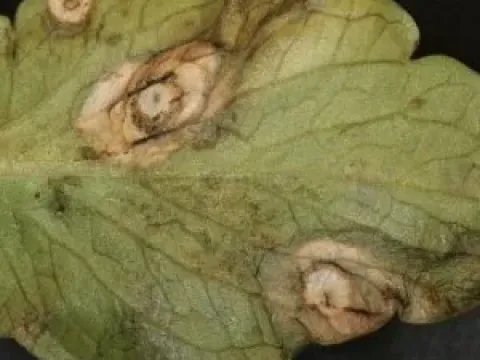
The primary external sign of the disease is the appearance of specific spots on the leaf blades of the affected plant. Initial symptoms manifest as small chlorotic dots that gradually enlarge over time.
What the section contains
Ramularia leaf spot
As the pathogen develops, the spots turn brown or dark brown, often featuring a lighter center surrounded by a darker margin. These necrotic zones can merge, covering a significant portion of the leaf surface.
Under conditions of high humidity, a characteristic grayish or whitish mold forms on the underside of the affected leaves. This mold represents the fungal sporulation mass, which is easily dispersed by the wind.
Severe infestation leads to premature yellowing and wilting of the foliage, which significantly reduces the overall aesthetic appeal and productivity of the crop. The plant may lose a large portion of its photosynthetic surface.
As the disease progresses, necrosis can spread to leaf petioles and stems, leading to deformation and an overall weakening of the plant's vital functions.
The causative agent of the disease is the microscopic fungus Ramularia psoraleae, which belongs to the class of Deuteromycetes. This pathogen specializes in infecting plants of the Fabaceae family, particularly the Psoralea genus.
The fungus is primarily a parasite, penetrating plant tissues through stomata or mechanical damage to the epidermis. Once inside, the mycelium spreads through the intercellular spaces, causing cell death.
The pathogen reproduces through conidia, which are formed in conidiophores gathered in clusters. These conidia vary in shape and size, ensuring rapid spread of the infection during the growing season.
The fungus overwinters as mycelium or conidia on plant debris left in the soil after harvest. In the spring, when favorable conditions return, the infection reactivates and attacks new sprouts.
The fungus exhibits high phenotypic plasticity, allowing it to adapt to various microclimatic conditions within the crop's cultivation zone.
The main factor promoting the development of Ramularia leaf spot is high air and soil humidity. Frequent rainfall, fog, and dew create an ideal environment for spore germination.
The disease develops most intensely in a temperature range between +15 and +22 degrees Celsius. Higher temperatures combined with high humidity significantly accelerate the incubation period.
Dense plantings contribute to poor air circulation, which prevents rapid evaporation of moisture from the leaves. Such conditions critically increase the risk of massive infection spread in agricultural fields.
Failure to rotate crops and cultivating Psoralea in the same spot for several years leads to the accumulation of inoculum in the soil, making plants more vulnerable to early infection.
Unbalanced nutrition, especially excess nitrogen fertilizer, triggers rapid vegetative growth, which results in looser plant tissue that is more susceptible to fungal mycelium penetration.
The harmfulness of Ramularia leaf spot lies in the disruption of photosynthesis due to significant damage to the leaf apparatus. This leads to the suppression of growth and development of the entire plant.
The disease negatively affects the accumulation of biologically active substances in plant organs, which is of critical importance when cultivating medicinal Psoralea commercially.
Early infection results in a noticeable reduction in seed yield and a decline in seed quality. Weakened plants are often unable to form healthy fruits or seeds.
In nurseries, infected seedlings lose their marketability and may die after being transplanted into open ground, causing direct economic losses to agricultural businesses.
Prolonged infection weakens the plant's immune system, opening the door for secondary infections, including bacterial rots, which can eventually destroy the entire crop.
The main protection strategy is to adhere to a crop rotation plan, ensuring Psoralea is not replanted in the same location for at least 3–4 years to break the fungus's life cycle in the soil.
The most important agrotechnical measure is the thorough removal and destruction of plant debris after the growing season. Tilling the soil helps accelerate the decomposition of infectious material.
It is recommended to use high-quality, healthy seeds that have been pre-treated with fungicides to protect seedlings from early infection.
During the active growth phase, preventive spraying with approved fungicides should be carried out upon the detection of the first disease signs. Rotating products is essential to prevent pathogen resistance.
- Thinning dense crops to improve ventilation.
- Balanced application of potassium and phosphorus fertilizers.
- Regular phytosanitary monitoring of plantations.