
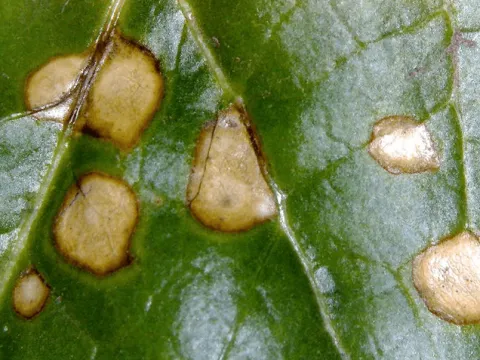
Ramularia leaf spot of beet
Ramularia beticola
The causative agent of the disease is the fungus Ramularia beticola, which is classified within the Deuteromycetes group. It is a persistent soil-borne pathogen that overwinters on crop residues.
What the section contains
Ramularia leaf spot of beet
The pathogen primarily attacks all types of beets, including sugar, fodder, and garden beets. Its lifecycle is driven by the production of conidia, which act as the main dispersal units for spreading the infection during the growing season.
Infection occurs when conidia land on leaf surfaces and germinate under favorable moisture conditions, with the fungus penetrating the leaf tissues through natural openings like stomata.
Once inside, the fungus colonizes the mesophyll, developing mycelium and eventually emerging back through the leaf surface to form visible spore clusters.
Because the fungus can survive in the soil for extended periods, it is considered a significant threat in areas with intensive beet production where crop rotation cycles are insufficient.
The first symptoms of Ramularia leaf spot appear on mature, older leaves as small, circular, brownish-gray lesions surrounded by a distinct dark or reddish-brown border.
As the disease progresses, the lesions enlarge, typically reaching 5–10 mm in diameter. The central part of these spots often turns grayish-white as the tissue dries out and becomes necrotic.
During periods of high humidity, a characteristic white to light-gray velvety or powdery growth appears on the underside of the leaves, directly corresponding to the spots on the upper side.
Severe infections lead to the coalescing of spots, covering large areas of the leaf blade, which eventually results in premature yellowing, browning, and death of the leaf.
Unlike other leaf spot diseases, the margins of Ramularia lesions may appear slightly irregular. Severely affected leaves often curl and wither, contributing to a rapid decline in the plant's photosynthetic capacity.
Ramularia leaf spot thrives in cool and humid weather conditions. An optimal temperature range for fungal development is between 15°C and 20°C.
High relative humidity, sustained rainfall, or heavy dew are essential for the germination of spores and the successful establishment of the infection on host plants.
Dense canopies, which restrict air circulation and maintain high moisture levels within the crop stand, significantly increase the rate of disease development.
The disease tends to manifest and spread rapidly during periods of cloudy weather where leaves remain wet for extended intervals, preventing drying and allowing fungal colonization.
Poor soil drainage or excessively moist field conditions can exacerbate the problem, making the crop more susceptible to rapid secondary infection cycles.
The primary economic impact of Ramularia leaf spot is the reduction of green leaf area, which severely limits the plant's ability to produce sugars through photosynthesis.
A significant reduction in leaf health directly correlates with lower root weight and decreased sucrose concentration, leading to lower yields and lower sugar extractability.
Plants affected by the disease are often prone to early senescence, which forces the plant to divert resources away from root growth to repair or replace foliage.
In cases of heavy infestation, the storage quality of the harvested roots can be negatively affected, increasing the susceptibility of the roots to storage rots.
Overall profitability is reduced due to both lower yield quality and the added costs required for fungicide applications to manage the disease during the season.
Integrated disease management is crucial for the control of Ramularia leaf spot, starting with a robust crop rotation program that excludes beets for at least 3–4 years.
Proper field sanitation, including the deep plowing of harvested crop residues, is a vital step to bury and speed the decomposition of fungal inoculum.
Fungicide applications are recommended when early symptoms are detected, particularly if weather forecasts indicate prolonged periods of rain or high humidity.
- Use of certified, high-quality, and disease-free seed.
- Control of weeds in the Amaranthaceae family, which act as reservoirs.
- Optimized plant density to improve air circulation within the rows.
- Balanced fertilization, with an emphasis on sufficient potassium to boost immunity.
Choosing resistant or tolerant hybrids is one of the most sustainable long-term strategies to minimize damage caused by this pathogen.