
Ramularia leaf spot
Ramularia collo-cygni
The disease is caused by the fungus Ramularia collo-cygni, an ascomycete pathogen that has become a significant threat to barley crops worldwide. It is known for its ability to persist in crop debris and seed material.
What the section contains
Ramularia leaf spot
The pathogen completes its life cycle by infecting various plant parts, primarily leaves. It produces conidia that disseminate through wind and rain splash, ensuring rapid spread across the field.
A key biological trait of this fungus is the production of toxins, such as rhynchosporidin, which accelerate leaf tissue necrosis. This chemical action is central to the rapid decline of infected barley plants.
The fungus is highly adaptable to changing environmental conditions, which has led to widespread distribution. It often remains latent until the host plant reaches specific physiological growth stages.
Current research highlights the difficulty in breeding resistant cultivars, as the pathogen displays significant genetic diversity, making it a persistent challenge for modern cereal production.
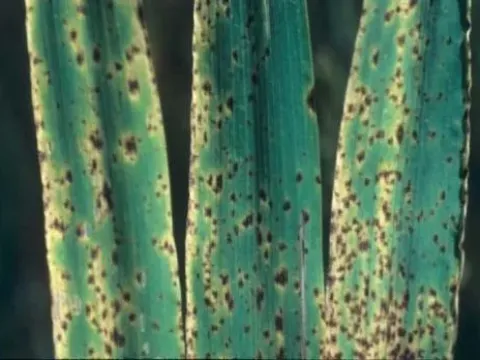
Early symptoms appear as small, dark brown spots on the lower leaves. These lesions are typically rectangular in shape, restricted by the leaf veins, which gives them a distinct look.
Under humid conditions, a characteristic grayish-white sporulation may be observed on the leaf surface. This indicates that the fungus is actively producing conidia for further dissemination.
As the infection progresses, individual spots merge to cover large areas of the leaf blade. This causes the leaves to chlorose and die prematurely, giving the field a scorched appearance.
The disease can also manifest on the upper leaves, leaf sheaths, and even the awns and glumes of the barley head. This severe infection significantly impairs the plant's photosynthetic capacity.
Diagnosis is sometimes difficult due to similarities with other leaf spotting diseases. Growers often require microscopic examination to confirm the presence of Ramularia collo-cygni in the field.
The development of Ramularia leaf spot is favored by moderate temperatures and high relative humidity. Frequent rainfall and prolonged leaf wetness are critical factors that trigger outbreaks.
The disease is most aggressive during the booting to flowering stages of barley. The dense canopy at this time creates a microclimate that effectively traps humidity, supporting fungal growth.
Stress factors such as nutrient deficiencies, drought, or extreme temperature fluctuations weaken the plant's natural defense mechanisms, making it more susceptible to infection.
Areas with high planting density are particularly prone to rapid disease spread. Once the lower canopy is infected, the movement of spores upward to the flag leaf occurs very quickly under humid conditions.
The presence of infected crop stubble from previous seasons acts as the primary inoculum source. Even minimal carryover can lead to massive disease pressure if weather conditions remain optimal.
Ramularia leaf spot is a highly destructive disease, with potential yield losses ranging from 10% to 30% depending on the severity of the infection and the timing of the outbreak.
The infection significantly degrades grain quality by reducing the thousand-kernel weight and overall grain filling. This is especially problematic for the malting barley industry.
Premature leaf senescence robs the plant of the nutrients needed to fill the grain properly. This results in shriveled, low-weight kernels that do not meet standard market specifications.
Severely infected crops often suffer from lodging, as the fungal damage compromises the structural integrity of the stem. This makes mechanical harvesting difficult and increases harvest losses.
Furthermore, the weakened tissue is prone to secondary colonization by saprophytic organisms, which further degrades the straw quality and may harbor other pathogens.
Effective management requires a proactive fungicide strategy. Applications are recommended from the booting stage to the emergence of the flag leaf to prevent the pathogen from reaching upper canopy levels.
Fungicides from the multi-site, strobilurin, and triazole groups are commonly used. Rotating these chemical classes is essential to manage the risk of the pathogen developing fungicide resistance.
Cultural practices, such as the thorough incorporation of crop residue and long-term crop rotation, are vital to reducing the initial inoculum levels present in the soil.
Choosing resistant or moderately tolerant barley varieties is a key strategy for integrated pest management. While no variety is immune, some offer better protection under high disease pressure.
Regular field monitoring is essential for timely intervention. By identifying early signs of the disease at the base of the plant, farmers can make informed decisions about the necessity of fungicide applications.