
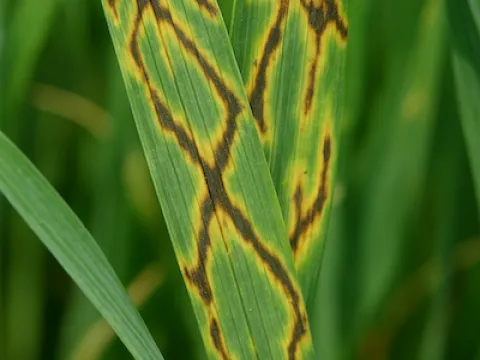
Net blotch of barley
Pyrenophora teres
The causative agent of the disease is the fungus Pyrenophora teres (anamorph Drechslera teres). It is an ascomycete pathogen that primarily affects barley, making it one of the most common and damaging diseases for this crop globally.
What the section contains
Net blotch of barley
The fungus's life cycle includes an asexual stage, producing conidia for dissemination during the growing season, and a sexual stage in the form of pseudothecia. Sexual reproduction usually occurs on crop residues, ensuring the survival of the infection during the off-season.
The pathogen's mycelium is capable of persisting on infected seeds and stubble left on the soil surface. Primary infection in spring occurs via conidia or ascospores, which are spread by wind and rain splashes.
The fungus is highly variable, allowing it to adapt to different environmental conditions and overcome the resistance of some barley varieties. Rapid accumulation of inoculum makes the pathogen extremely dangerous under favorable climatic conditions.
The biology of the pathogen enables it to infect plants at all stages of development, from seedlings to the milk-dough stage of grain, provided that there is sufficient moisture.
The first symptoms appear as small brown spots that eventually stretch along the leaf veins. A characteristic feature is the net-like pattern caused by the alternation of dark necrotic areas and chlorotic tissues.
As the disease progresses, the spots enlarge, covering a significant part of the leaf blade, which leads to premature drying of the leaves. The infection starts from the lower canopy and gradually spreads upwards to the flag leaf.
In high humidity, a sparse olive-colored fungal growth can often be observed on the spots. In addition to leaves, the pathogen can infect stems, leaf sheaths, and even glumes, which reduces grain quality.
Symptomatology may vary depending on variety resistance and weather conditions, manifesting either as the classic "net" pattern or as large brown blotches without a distinct net-like appearance.
Visual diagnosis is difficult in the early stages; however, as the disease develops, the affected areas coalesce, leading to massive leaf necrosis and reduced photosynthetic activity.
The most favorable conditions for Pyrenophora teres development are moderate temperatures ranging from +15 to +22 degrees Celsius. A key factor for infection intensity is high atmospheric humidity.
Rainfall and heavy dew during morning hours significantly accelerate spore germination and fungal penetration into plant tissues. Irrigation or prolonged rains during the tillering phase contribute to the epiphytotic development of the disease.
Dense crop stands create a microclimate with reduced air circulation, promoting moisture retention in the root zone and on the leaves. This provides an ideal environment for rapid pathogen spread between plants.
Poor crop rotation practices, where barley is returned to the same field too soon, lead to the accumulation of inoculum in the soil. The more crop residue left in the field, the higher the risk of early seedling infection.
Temperature fluctuations combined with night fogs activate spore-producing mechanisms, allowing the fungus to infect large areas in a short time, especially if the plants are stressed.
Net blotch is a major cause of barley yield loss, resulting in reduced thousand-grain weight and shriveled grain. Severe infection leads to a shortened growing season and premature maturation.
Infected plants exhibit a significant reduction in photosynthetic intensity, which prevents proper grain filling. As a result, farmers obtain lower quality produce with reduced protein and starch content.
The damage also manifests as weakened plant immunity, making them more susceptible to other cereal diseases such as powdery mildew or rust, which worsens the overall plant stress.
Economic losses can reach 20-40 percent or more in years with high humidity. Infection of the upper leaves is particularly critical, as these leaves provide the primary nutrient flow to the ear.
Massive infection of the crop can lead to lodging, which severely complicates harvesting and causes additional grain losses during combine operation.
The primary control method is the use of resistant or tolerant barley varieties. Breeding programs aim to create genetic lines capable of withstanding a wide range of pathogen races.
Agrotechnical measures include adhering to a crop rotation with a 2-3 year gap between cereal crops. It is also critical to perform quality deep plowing of crop residues into the soil.
The use of treated seed material helps reduce the level of primary infection transmitted via seeds. Effective systemic seed treatments provide protection for seedlings during the early growth stages.
During the growing season, the application of fungicides is recommended if the infection level exceeds the economic threshold. Treatments are most effective when the first signs of the disease appear on the flag leaf.
- Adhering to optimal sowing dates to prevent seedlings from being exposed to high humidity.
- Balanced application of mineral fertilizers, especially potassium, which increases tissue resistance.
- Timely control of volunteer barley, which acts as a reservoir for the infection.