
Sesame cercospora leaf spot
Pseudocercospora sesami
The causal agent of sesame cercospora leaf spot is the fungal pathogen Pseudocercospora sesami (formerly known as Cercospora sesami). This fungus is a specialized parasite that exclusively attacks sesame plants.
What the section contains
Sesame cercospora leaf spot
The infection persists in crop debris within the soil and can also be transmitted via infected seeds. During the growing season, the fungus spreads primarily through conidia, which are disseminated by wind, rain splashes, or mechanical operations.
The life cycle of the pathogen is closely linked to moisture levels. Upon landing on a leaf surface, the spore germinates and penetrates plant tissue through stomata or minor epidermal wounds.
The mycelium grows within the intercellular spaces, secreting enzymes that damage plant cells and initiate necrosis. Eventually, the fungus produces conidiophores that emerge through the stomata, creating a characteristic dark, velvety growth.
As a host-specific pathogen, it is a persistent threat in regions where sesame is grown intensively, requiring systematic management to minimize its impact on productivity.
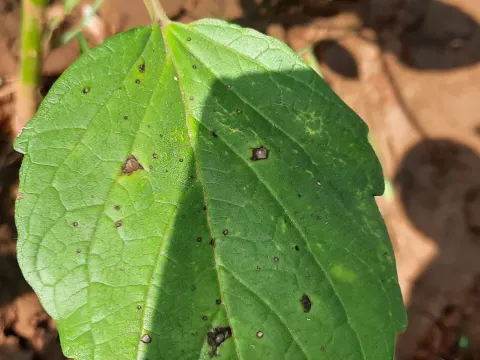
The initial symptoms appear on the lower leaves as small, distinct brown or dark spots. Over time, these spots expand, often developing a gray or light-colored center surrounded by a dark margin.
A chlorotic halo frequently develops around the spots, indicating the plant's response to fungal toxins. Under high humidity, a dark, dusty growth of fungal spores becomes visible on the underside of the infected leaves.
As the infection progresses, individual spots may coalesce, covering large portions of the leaf blade. This leads to premature yellowing, withering, and shedding of leaves, beginning from the base of the plant.
Stems and seed capsules can also be infected, showing elongated dark necrotic streaks. These lesions can weaken the plant structure and disrupt the transport of nutrients to the developing seeds.
In severe cases, floral parts and young pods may drop prematurely, significantly reducing the total number of mature seed-bearing capsules per plant.
Cercospora leaf spot thrives in warm, humid conditions. The optimal temperature range for spore germination and mycelial growth is between 20°C and 28°C, which often coincides with the peak growth phase of sesame.
High relative humidity (above 75%) is a critical factor for the epidemic development of the disease. Frequent rainfall, heavy dews, or prolonged fog provide the necessary moisture for the fungus to multiply.
High-density planting creates a microclimate with poor air circulation, allowing humidity to remain high within the canopy. This environment is ideal for the rapid transmission of the pathogen from infected leaves to healthy ones.
Poor soil drainage and waterlogging can weaken the plant's natural immune system, making it more susceptible to infection by Pseudocercospora sesami compared to plants grown in well-aerated conditions.
The flowering and seed-filling stages are the most critical, as the plant's resources are channeled toward reproduction, leaving it more vulnerable to the damaging effects of the fungus.
The primary damage caused by cercospora leaf spot is the significant reduction in leaf photosynthetic area, which limits the plant's ability to produce the energy required for seed development.
This impairment directly leads to lower yields, characterized by shriveled seeds, reduced 1000-seed weight, and lower oil content, which compromises the market value of the harvest.
Premature defoliation strips the plant of its protective foliage, exposing the stem to intense sunlight and potential secondary infections by opportunistic pathogens.
Infected capsules may fail to develop properly and can split before maturity, resulting in significant seed loss during mechanical harvesting operations.
In epidemic scenarios, total yield losses can be substantial, often exceeding 30-50%, depending on the duration of the favorable weather for the fungus and the susceptibility of the chosen sesame variety.
The first line of defense is the use of high-quality, disease-free seed. Treating seeds with appropriate fungicides before planting is essential to eliminate any surface-borne inoculum.
Crop rotation is a fundamental management practice. Avoiding sesame cultivation on the same field for at least 3-4 years breaks the survival cycle of the pathogen in the soil and reduces the initial infection pressure.
Proper field management, including deep plowing after harvest, helps to bury infected crop residues, accelerating their decomposition and reducing the survival rate of the fungus.
- Selection of resistant or tolerant sesame varieties.
- Control of weed species that may act as alternative hosts.
- Adjusting planting density to improve canopy airflow.
- Timely application of fungicides upon the detection of initial spots.
When environmental conditions favor disease outbreak, prophylactic or curative fungicide applications—using copper-based products, triazoles, or strobilurins—should be employed to protect the crop and maintain yield quality.