
Pseudocercospora leaf spot of yam
Pseudocercospora carbonacea
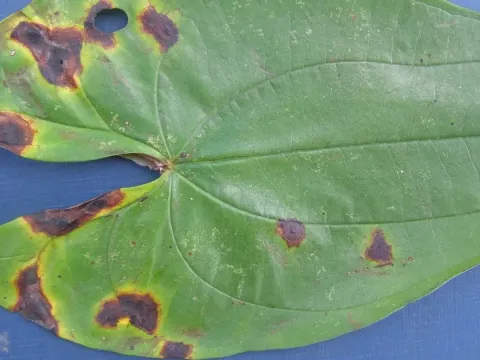
The primary symptom of the disease is the appearance of dark, almost black spots on the yam leaves, which are typical of Pseudocercospora carbonacea infections.
What the section contains
Pseudocercospora leaf spot of yam
These spots are often angular in shape, bounded by leaf veins, or circular with a necrotic center that may eventually fall out, creating a shot-hole effect.
On the underside of the infected leaves, a dense, velvety layer of fungal spores (conidia) can often be observed during humid conditions.
In cases of severe infestation, the leaves turn yellow prematurely, curl, and wither, leading to extensive defoliation of the entire vine.
The infection can also affect the stems, manifesting as elongated brown necrotic lesions that disrupt the transport of nutrients to the tubers.
The disease is caused by the ascomycete fungus Pseudocercospora carbonacea, a pathogen specialized in attacking various species of yam (Dioscorea).
The pathogen survives between growing seasons as mycelium and conidia in infected plant debris, soil, and on infected tubers used for propagation.
Dissemination of the fungus occurs primarily through wind, rain splashes, and insects, which carry spores to healthy tissues in moist environments.
The fungus penetrates the plant through stomata or mechanical wounds, subsequently colonizing the leaf mesophyll and inhibiting normal metabolic processes.
The biological cycle of the fungus is characterized by high adaptability and the ability to persist for long periods in infected host remains.
High relative humidity and frequent rainfall are the most favorable conditions for the development and spread of Pseudocercospora carbonacea.
The optimal temperature range for the rapid growth of the fungus and sporulation is between +22 and +28 degrees Celsius.
Dense planting configurations that restrict air circulation create a microclimate conducive to rapid disease development within the field.
Dew, fog, and prolonged periods of leaf wetness significantly increase the infection rate, as water is essential for spore germination and invasion.
Plants under nutrient stress or in weak physiological condition are significantly more susceptible to infection compared to healthy, well-fertilized plants.
The major harm caused by this disease is the significant reduction in the leaf surface area, which leads to a dramatic decrease in photosynthetic activity.
As the plant loses its ability to produce enough carbohydrates, the growth and development of the yam tubers are severely hampered.
Yield losses can range from 15 to 40 percent, depending on the severity of the infection and the timing of the disease outbreak during the growth cycle.
Infected tubers exhibit poor storage quality and are more prone to decay, which reduces their value as both food products and planting material.
Persistent infection in a field can lead to total crop failure, rendering the harvest unsuitable for commercial sale or consumption.
The first line of defense is the use of healthy, disease-free planting material to prevent the introduction of the pathogen into new areas.
Crop rotation practices should be strictly followed, ensuring that yams are not replanted in the same field for at least three to four years.
Proper field sanitation, including the removal and deep burial or destruction of plant debris, is crucial for reducing the primary inoculum source.
The application of protective or systemic fungicides is recommended upon the early detection of symptoms to prevent widespread epidemic development.
- Maintaining optimal plant spacing to promote adequate ventilation.
- Regular field scouting to identify infection spots at an early stage.
- Balanced fertilization to boost the plant's natural resistance.