
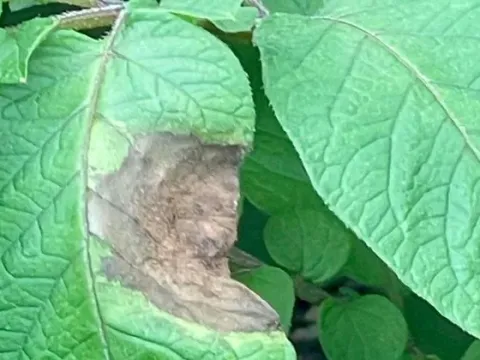
Andean Late Blight
Phytophthora andina
The causal agent of this disease is the oomycete Phytophthora andina, which is genetically related to other destructive species of the Phytophthora genus.
What the section contains
Andean Late Blight
This pathogen acts as a specialized parasite, targeting plants within the Solanaceae family, and relies on living host tissue to complete its life cycle.
Phytophthora andina is characterized by high genetic plasticity, allowing it to adapt rapidly to different environments and potentially overcome host resistance.
The biology of the pathogen involves the production of zoospores, which facilitate swift transmission through water films and soil splashes to healthy plant parts.
Studies indicate that while its range was historically limited, its evolutionary history and hybridization capabilities pose a continuous challenge for plant pathologists.
Initial symptoms manifest as small, dark, water-soaked spots on leaves that expand rapidly, eventually resulting in necrotic tissue.
Under conditions of high humidity, a characteristic white or grayish fungal-like growth appears on the undersides of the affected leaf blades, signifying active sporulation.
Stems become dark, brittle, and necrotic, leading to the rapid wilting and collapse of the entire aerial portion of the plant.
On potato tubers or tomato fruits, the disease causes firm, brownish-red lesions that eventually penetrate deep into the tissue, often leading to secondary rot.
A hallmark of the disease is the extreme speed at which lesions spread, often rendering a healthy field severely damaged in a matter of a few days.
Development is heavily dependent on cool to moderate temperatures and high moisture levels, which are typical for its native Andean high-altitude regions.
The presence of free moisture (dew or rain) on leaf surfaces is essential for the germination and penetration of the pathogen into the host tissue.
Relative humidity levels consistently above 80-85% create the perfect environment for the exponential growth of Phytophthora andina.
Dense crop canopies that limit air circulation exacerbate the situation by maintaining high humidity levels within the foliage of the plants.
Infected soil and crop debris serve as the primary reservoir for the pathogen, ensuring its survival during periods unfavorable for plant growth.
Andean Late Blight is devastating to crop yields, with the potential to destroy the entire production of potatoes or tomatoes during a favorable season.
The disease not only reduces yield quantity but also drastically lowers the quality, making harvested products unsuitable for long-term storage or human consumption.
The rapid spread of the disease forces farmers to intervene aggressively, often increasing the overall cost of production and environmental impact.
By killing the photosynthetic foliage, the pathogen prevents the development of tubers and fruits, resulting in complete economic loss for the affected farm.
The pathogen's ability to quickly adapt can render traditional management strategies ineffective, necessitating constant research into new resistant cultivars.
The foundation of management lies in the utilization of high-quality, pathogen-free seed tubers and seedlings to minimize the risk of introducing the infection.
Strict adherence to crop rotation, ensuring that Solanaceous crops are not planted in the same field for several consecutive seasons, is vital for disease control.
Preventive application of fungicides should be based on weather modeling, targeting periods when environmental conditions favor pathogen sporulation.
- Sanitation practices including the removal and destruction of all infected crop residues.
- Increasing plant spacing to improve airflow and reduce humidity in the lower canopy.
- Monitoring the field consistently for early detection of initial infection focal points.
Integrated Pest Management (IPM) strategies, combining chemical treatments with resistant varieties, remain the most effective approach to mitigating damage.