
Anaptychia
Anaptychia
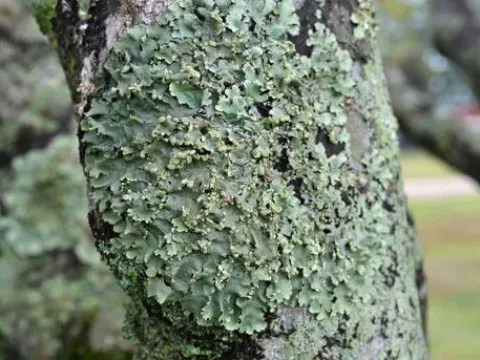
Anaptychia typically appears as a foliose thallus that attaches firmly to tree bark. It forms small, rosette-like structures consisting of narrow lobes that often exhibit gray, brownish, or ash-colored tones.
What the section contains
Anaptychia
When inspected closely, one can observe apothecia, which are the reproductive fruiting bodies of the lichen. These structures look like small, circular discs often found on the margins or center of the thallus, aiding in species identification.
The lobes of this lichen are often branched in a radial or irregular pattern, with the edges frequently lifted slightly above the bark surface. The texture is usually matte or slightly glossy, which helps distinguish it from other local epiphytic species.
Significant growth of Anaptychia on a trunk can alter the bark's texture, making it rougher and prone to trapping moisture. This creates a visible "crusty" effect that is easily noticed from a distance on affected woody plants.
Unlike parasitic fungi, this lichen does not penetrate the tree's internal tissues. However, its presence often indicates that the branch growth has slowed, providing a stable surface for the lichen to settle over time.
Anaptychia is not a plant disease in the strict sense but a genus of lichen. It is a symbiotic organism consisting of a fungal component (mycobiont) and an algal component (photobiont) living together in a mutually beneficial relationship.
Classified under the family Physciaceae, these organisms are epiphytes. They use the tree bark merely as a physical support system and do not extract sap or nutrients from the host tree, making them ecologically independent of the tree's internal health.
There are numerous species within the Anaptychia genus, each adapting to specific environmental conditions. They are found worldwide, colonizing both hardwood trees and various rocky substrates depending on moisture levels.
Reproduction occurs through spores released from the apothecia or via fragmentation of the thallus. These pieces can be dispersed by wind or rain, allowing the lichen to colonize new areas on the host plant during humid conditions.
In environmental science, Anaptychia species are recognized as bioindicators. Because they are sensitive to air quality, particularly sulfur dioxide levels, their presence or absence is used to measure the cleanliness of an ecosystem.
The development of Anaptychia requires high atmospheric humidity and a stable moisture supply on the bark surface. It thrives in environments with frequent mist, rain, or proximity to water bodies, which provide the necessary hydration.
Old trees with deeply furrowed bark serve as perfect substrates. The fissures allow for the accumulation of organic dust and debris, which create a nutrient-rich base for the lichen spores to anchor and begin growth.
Shaded areas within a dense canopy provide the ideal light levels. Since these lichens are sensitive to excessive drying from direct sunlight, the canopy acts as a protective shield, maintaining the cool, humid microclimate they need.
Temperature plays a crucial role in their colonization. They are most active during moderate temperatures, usually in the spring and autumn months, when moisture remains on the bark for extended periods without evaporating rapidly.
Neglected gardens or orchards are particularly prone to Anaptychia colonization. Without regular pruning, the canopy becomes dense and poorly ventilated, which is exactly the environmental niche where these lichens flourish.
While Anaptychia is not a parasite, its heavy growth on fruit trees causes significant indirect damage. The dense crust serves as an ideal wintering ground for harmful insects, mites, and spores of true pathogenic fungi.
The layer of lichen retains moisture on the bark surface, preventing it from drying out. This prolonged wetness can lead to the deterioration of the outer bark and the promotion of rot, which may eventually reach the cambium layer.
Massive colonization can interfere with the bark's normal respiratory process. By covering the lenticels, the lichen limits the tree's ability to exchange gases, which is vital for the health of woody tissues during the growing season.
The presence of lichens often suggests that the tree is under stress or experiencing premature aging. An overgrown tree suffers from reduced vigor, which lowers its overall yield and increases vulnerability to harsh winter conditions.
Visually, an infested tree looks neglected, which can complicate pest control efforts since the lichen creates a protective hiding place for various pathogens, making it harder for chemical sprays to contact them effectively.
Mechanical removal is the primary method of control. During the dormant season, when the temperature is above freezing, one can use a stiff brush or a specialized scraper to gently remove the lichen from the bark without harming the living tissues.
After mechanical cleaning, it is essential to disinfect the trunk. Applying a solution of copper sulfate or iron sulfate helps eliminate any remaining spores and prevents the rapid recurrence of the lichen colony.
Preventative maintenance through annual pruning is vital. By thinning the canopy, you improve air circulation and sunlight penetration, which helps keep the bark dry and makes the environment unsuitable for lichen survival.
Boosting the tree's health through proper fertilization and irrigation promotes vigorous bark growth. A tree that grows actively will naturally shed older, colonized layers of bark, preventing the buildup of epiphytes.
- Perform regular sanitary pruning every spring.
- Apply lime whitewash with fungicide additives to trunks.
- Improve overall orchard ventilation.
- Monitor trees annually for early signs of lichen colonization.