
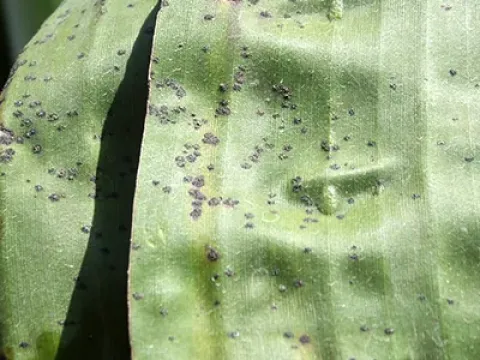
Banana phyllosticta leaf spot
Phyllosticta musarum
The causal agent of banana phyllosticta leaf spot is the ascomycete fungus Phyllosticta musarum (syn. Guignardia musae). This pathogen specifically targets the foliage of the Musa genus.
What the section contains
Banana phyllosticta leaf spot
The fungus produces pycnidia, which are small fruiting bodies containing conidia. These spores serve as the primary inoculum for the disease and are dispersed primarily by water splashes and wind.
The fungus survives between cropping cycles in crop debris and infected leaf tissue left on the ground. This persistence allows it to re-emerge rapidly when environmental conditions become suitable.
Upon landing on a leaf, conidia germinate and penetrate the host tissue. The pathogen then colonizes the intercellular spaces, secreting enzymes that degrade plant cells and lead to lesion formation.
The life cycle is closely linked to the availability of moisture. The fungus has evolved to efficiently propagate during the rainy seasons characteristic of banana-growing tropical regions.
Symptoms typically start as small, circular or oval spots on the leaves. These spots are initially brown or grayish and develop a characteristic dark margin over time.
A distinctive diagnostic feature is the presence of tiny, black, pimple-like structures in the center of the lesions, known as pycnidia. These are visible to the naked eye or under a magnifying lens.
As the disease progresses, these lesions may coalesce, creating large necrotic zones. This results in significant leaf tissue loss, which impairs the plant's ability to produce energy through photosynthesis.
Infected leaves often show yellowing (chlorosis) around the necrotic spots. Eventually, the affected leaf tissue dies, and the leaf may droop and collapse prematurely.
While the symptoms are mostly foliage-focused, severe infections can affect the overall health of the entire plant, especially if the infestation reaches the younger upper leaves.
High relative humidity, consistently above 80%, is the primary environmental driver for Phyllosticta musarum development. Frequent rainfall facilitates the splash-dispersal of spores.
Warm temperatures, ranging between 22°C and 28°C, accelerate the fungal metabolic processes and shorten the incubation period, leading to faster disease cycles.
Plantations with dense planting patterns often suffer more due to poor air circulation. Stagnant moisture on leaf surfaces provides the perfect window for spore germination.
Lack of proper field sanitation allows the fungus to remain in the vicinity of healthy plants. Dead leaves left in the plantation act as a reservoir for the pathogen.
Plants under nutrient stress or suffering from pests are more susceptible to infection, as their natural defense mechanisms are compromised by external environmental factors.
The primary impact of the disease is the reduction of the photosynthetic surface area, which directly translates to slower plant growth and delayed bunch development.
Crop yields suffer both in quantity and quality. Poor nutrition due to leaf loss leads to smaller bananas and potentially deformed fruit development.
Exposure of the banana bunch to direct sunlight, caused by premature leaf drop, can lead to fruit sunburn, significantly reducing the market value of the produce.
The increased need for intensive crop management, including fungicide applications and sanitation, increases the cost of production and lowers overall profitability.
In severe cases, the reduced photosynthetic efficiency leaves the plants more vulnerable to other secondary infections and environmental stressors like wind damage.
Sanitation is the cornerstone of control. Regularly pruning and removing infected leaves significantly lowers the inoculum levels within the plantation.
Optimizing plant spacing ensures better ventilation, allowing leaves to dry faster after rain, which inhibits the conditions necessary for spore germination.
Chemical control using copper-based fungicides or systemic azole compounds is effective if applied timely. Rotation of fungicides is essential to prevent resistance development.
Using certified, disease-free planting material prevents the introduction of the pathogen into clean areas, serving as the first line of defense.
Integrated Pest Management (IPM) strategies, including monitoring and early detection, allow for targeted interventions that keep the disease below the economic threshold.