
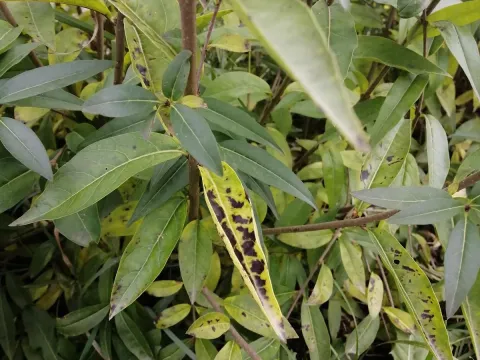
Phyllosticta leaf spot on privet
Phyllosticta ligustricola
The causative agent of this disease is the deuteromycete fungus Phyllosticta ligustricola. This pathogen invades plant tissue, specifically targeting the leaf epidermis and mesophyll to obtain nutrients.
What the section contains
Phyllosticta leaf spot on privet
The fungus survives the winter primarily in the form of pycnidia located on fallen, infected leaves or within bark fissures of the privet twigs. As temperatures rise in spring, spores are released and dispersed by rain splash or wind.
The lifecycle of the pathogen is highly humidity-dependent. The conidia are resilient and can remain viable in the soil or plant debris for extended periods, creating a persistent risk of re-infection each season.
Once established, the mycelium spreads within the leaf, destroying chlorophyll and disrupting the plant's photosynthetic capability. This leads to progressive necrosis and a significant decline in the host's overall health.
Throughout the growing season, the fungus produces secondary spores within pycnidia, which manifest as minute black specks on the leaf surface, enabling rapid spread under favorable moisture conditions.
The primary symptom is the appearance of small, circular or irregular spots on the leaves. These spots usually feature a tan or light brown center surrounded by a distinct dark brown or reddish margin.
As the infection progresses, spots may enlarge and coalesce, covering significant portions of the foliage. This causes the leaves to yellow prematurely and drop, which is a classic symptom of advanced infection.
The fungus can also affect young shoots, causing stunting and potential dieback. This is particularly problematic in formal privet hedges where foliage uniformity is highly valued.
Under conditions of high humidity, a faint grayish spore mass may be visible on the necrotic spots, serving as a key diagnostic feature for differentiating this disease from other leaf spot pathogens.
Heavy infections result in severe defoliation by mid-summer, leaving the shrub vulnerable to heat stress and reducing its ability to prepare for winter dormancy.
Phyllosticta leaf spot thrives in warm, humid weather. Optimal development occurs when temperatures range between 18°C and 25°C, coupled with high relative humidity or frequent rainfall.
Poorly ventilated, dense plantings of privet are highly susceptible. Lack of airflow prevents foliage from drying out, allowing spores to germinate and infect the plant tissue effectively.
Overhead irrigation significantly contributes to the spread of the disease by splashing spores from the soil and lower leaves onto the healthy upper canopy, facilitating a rapid epidemic within the shrub.
Excessive use of nitrogen fertilizers promotes rapid, succulent growth that is physically easier for the fungus to penetrate, often making the plant more susceptible to the initial infection.
Debris from previous seasons left around the base of the plants provides a constant reservoir for the pathogen. Without sanitation, this becomes the primary driver of recurring annual outbreaks.
The main impact of this disease is the loss of aesthetic value, which is detrimental to the use of privet as an ornamental hedge. Defoliation leaves unsightly gaps in the plant's structure.
Chronic infection drains the plant of energy, leading to a general decline in vigor. This makes the privet more susceptible to secondary stressors, including pests and drought.
The premature loss of foliage reduces the plant's carbohydrate reserves, making it more prone to winter injury. In severe cases, repeated annual infections can lead to the death of weaker shrubs.
The disease reduces the plant's biomass, affecting growth rates and complicating pruning and maintenance tasks for gardeners and landscapers.
Given its ability to spread, an infected privet hedge can become an infection focal point for other susceptible woody shrubs in the garden, necessitating comprehensive management strategies.
Sanitation is the cornerstone of control. Removing and destroying all fallen leaves at the end of the season significantly reduces the amount of overwintering inoculum in the garden.
Pruning is essential to improve airflow through the canopy. By thinning the hedge, you ensure that leaves dry quickly after rain, which creates an environment hostile to fungal growth.
Preventative applications of copper-based fungicides can be very effective if timed correctly before the disease spreads. Spraying should begin early in the spring as soon as conditions favor the fungus.
For more severe cases, systemic fungicides from the triazole or strobilurin classes are recommended. It is vital to rotate different chemical classes to prevent the fungus from developing resistance.
- Switch to drip irrigation to keep water off the foliage.
- Apply balanced fertilization to avoid excess succulent growth.
- Monitor the plants regularly for the first signs of black pycnidia.