
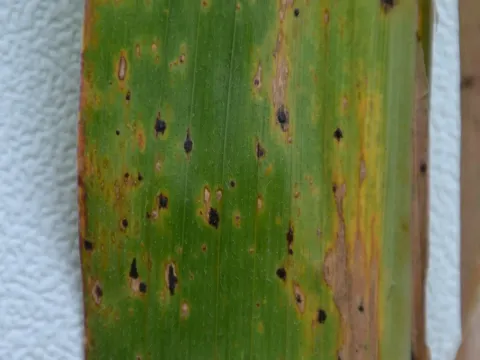
Sugarcane phyllachorosis
Phyllachora sacchari
The causative agent of the disease is the ascomycete fungus Phyllachora sacchari, which is a specialized obligate parasite.
What the section contains
Sugarcane phyllachorosis
The fungus develops within the leaf tissues, forming characteristic stromatic structures where spores are produced for reproduction.
Spores are disseminated primarily through wind and water splashes, allowing the pathogen to spread efficiently across sugarcane fields.
The survival of the fungus is largely dependent on infected crop residues remaining in the field between growing seasons.
Its biological cycle is strictly adapted to the sugarcane plant, making it a persistent challenge in humid tropical cultivation regions.
The primary symptom is the emergence of small, shiny black spots on the surface of the leaves, representing fungal fruiting bodies.
These black stroma are often surrounded by a chlorotic halo, indicating the physiological stress caused by the parasitic presence.
As the disease progresses, these lesions may merge, leading to extensive tissue necrosis and eventual drying of the leaf blade.
The plants lose their photosynthetic capability, which is evidenced by yellowing and early senescence of the foliage.
- Shiny black stromata appearing on both sides of leaves.
- Chlorotic halos around fungal infection sites.
- Premature leaf death and drying of the canopy.
The disease thrives in environments with high humidity and frequent rainfall, which are essential for spore germination.
Dense crop stands create a microclimate with restricted air movement, facilitating the spread of Phyllachora sacchari.
Moderate temperatures combined with moisture represent the ideal conditions for the fungus to complete its life cycle rapidly.
Plants that are physiologically weakened due to nutrient deficiencies or environmental stress show higher susceptibility to infection.
Dew and foggy conditions provide sufficient surface moisture for the infection process to initiate on healthy leaf surfaces.
The reduction in photosynthetic leaf area leads to a significant decrease in sugar accumulation within the sugarcane stalks.
Economic damage is caused by both the lower yield of total biomass and the decrease in sugar content for industrial processing.
Chronic infections weaken the plant’s overall vitality, making it prone to opportunistic secondary infestations by other pests.
Large-scale outbreaks can lead to substantial financial losses for sugarcane plantations due to decreased crop quality and weight.
Neglecting management practices can turn localized outbreaks into widespread epidemics that compromise entire harvest cycles.
Selecting and planting resistant sugarcane cultivars is the most effective long-term strategy for managing this fungal disease.
Sanitation practices, including the removal and destruction of infected plant debris, are crucial to reducing the initial inoculum.
Implementing proper planting density improves air circulation, which helps keep the leaf canopy dry and inhibits fungal growth.
Fungicide application during the early stages of disease development can prevent the massive release of spores across the field.
Adopting balanced fertilization programs increases plant resistance and helps sugarcane withstand the stress caused by the fungus.